Machu Picchu

From Wikipedia, the free encyclopedia
File:Peru physical map.svg
Machu Picchu (in hispanicized spelling, Spanish pronunciation: [ˈmatʃu ˈpiktʃu]) or Machu Pikchu (Quechua machu old, old person, pikchu peak; mountain or prominence with a broad base which ends in sharp peaks,[1] “old peak”, pronunciation [ˈmɑtʃu ˈpixtʃu]) is a 15th-century Inca site located 2,430 metres (7,970 ft) above sea level.[2][3] It is located in the Cusco Region, Urubamba Province, Machupicchu District in Peru.[4] It is situated on a mountain ridge above the Sacred Valley which is 80 kilometres (50 mi) northwest of Cusco and through which the Urubamba River flows. Most archaeologists believe that Machu Picchu was built as an estate for the Inca emperor Pachacuti (1438–1472). Often mistakenly referred to as the “Lost City of the Incas”, it is perhaps the most familiar icon of Inca civilization.

The Incas built the estate around 1450, but abandoned it a century later at the time of the Spanish Conquest. Although known locally, it was unknown to the outside world before being brought to international attention in 1911 by the American historian Hiram Bingham. Since then, Machu Picchu has become an important tourist attraction. Most of the outlying buildings have been reconstructed in order to give tourists a better idea of what the structures originally looked like.[5] By 1976, thirty percent of Machu Picchu had been restored.[5] The restoration work continues to this day.[6]

Since the site was not known to the Spanish during their conquest, it is highly significant as a relatively intact cultural site. Machu Picchu was declared a Peruvian Historical Sanctuary in 1981 and a UNESCO World Heritage Site in 1983.[3] In 2007, Machu Picchu was voted one of the New Seven Wonders of the World in a worldwide Internet poll.

Machu Picchu was built in the classical Inca style, with polished dry-stone walls. Its three primary structures are the Inti Watana, the Temple of the Sun, and the Room of the Three Windows. These are located in what is known by archaeologists as the Sacred District of Machu Picchu.[citation needed]

Machu Picchu is vulnerable to threats. While natural phenomena like earthquakes and weather systems can play havoc with access, the site also suffers from the pressures of too many tourists. In addition, preservation of the area’s cultural and archaeological heritage is an ongoing concern. Most notably, the removal of cultural artifacts by the Bingham expeditions in the early 20th century gave rise to a long-term dispute between the government of Peru and the custodian of the artifacts, Yale University.[7][8]

History

Hiram Bingham III at his tent door near Machu Picchu in 1912

Machu Picchu was built around 1450, at the height of the Inca Empire.[9] The construction of Machu Picchu appears to date from the period of the two great Incas, Pachacutec Inca Yupanqui (1438–71) and Tupac Inca Yupanqui (1472–93).[10] It was abandoned just over 100 years later, in 1572, as a belated result of the Spanish Conquest.[9][11] It is possible that most of its inhabitants died from smallpox introduced by travelers before the Spanish conquistadors arrived in the area.[12] The latter had notes of a place called Piccho, although there is no record of the Spanish having visited the remote city. The types of sacred rocks defaced by the conquistadors in other locations are untouched at Machu Picchu.[11]

Hiram Bingham theorized that the complex was the traditional birthplace of the Incan “Virgins of the Suns”.[13]

More recent research by scholars such as John Howland Rowe and Richard Burger, has convinced most archaeologists that Machu Picchu was an estate of the Inca emperor Pachacuti.[11] In addition, Johan Reinhard presented evidence that the site was selected because of its position relative to sacred landscape features such as its mountains that are purported to be in alignment with key astronomical events important to the Incas.[citation needed]

Johan Reinhard believes Machu Picchu to be a sacred religious site. This theory stands mainly because of where Machu Picchu is located. Reinhard calls it “sacred geography” because the site is built on and around mountains that hold high religious importance in the Inca culture and in the previous culture that occupied the land. At the highest point of the mountain which Machu Picchu was named after, there are “artificial platforms [and] these had a religious function, as is clear from the Inca ritual offerings found buried under them” (Reinhard 2007). These platforms also are found in other Incan religious sites.

The site’s other stone structures have finely worked stones with niches and, from what the “Spaniards wrote about Inca sites, we know that these [types of] building[s] were of ritual significance” (Reinhard 2007). This would be the most convincing evidence that Reinhard points out because this type of stylistic stonework is only found at the religious sites so it would be natural that they would exist at this religious site.[14]

Another theory maintains that Machu Picchu was an Inca llaqta, a settlement built to control the economy of conquered regions. Yet another asserts that it may have been built as a prison for a select few who had committed heinous crimes against Inca society.[citation needed] An alternative theory is that it is an agricultural testing station. Different types of crops could be tested in the many different micro-climates afforded by the location and the terraces; these were not large enough to grow food on a large scale, but may have been used to determine what could grow where.[citation needed]

View of the city of Machu Picchu in 1912 showing the original ruins after major clearing and before modern reconstruction work began.[5][6]

Although the citadel is located only about 80 kilometers (50 mi) from Cusco, the Inca capital, the Spanish never found it and consequently did not plunder or destroy it, as they did many other sites.[11] Over the centuries, the surrounding jungle grew over the site, and few knew of its existence.

Hiram Bingham was an American historian employed as a lecturer at Yale University, he was not a trained archaeologist. In 1909 on his way back from attending the Pan-American Scientific Congress in Santiago he traveled through Peru and was invited to explore the Inca ruins at Choqquequirau in the Apurimac Valley, which gave him an interest in Inca ruins, and an introduction to Peruvian President Leguia. He organized the 1911 Yale Peruvian Expedition with one of its objectives to search for the lost city of Vitcos, the last capital of the Incas. He researched sources and consulted Carlos Romero, a historian in Lima who showed Bingham helpful references and Father Calancha’s Chronicle.

Armed with this information the expedition went down the Urubamba River on the new road that was completed in 1895. En route he asked local people to show them Inca ruins. By the time they camped at Mandor Pampa with Huayna Picchu 2000 feet above them on the opposite bank they had already examined several ruins, including five sites that Herman Tucker explored. But none fitted the descriptions they had of Vitcos.

At Mandor Pampa Bingham asked a local farmer and innkeeper, Melchor Arteaga, if he knew of any ruins in the area and he said he knew of some excellent ruins on the top of Huayna Picchu.[15] The next day, 24th July 1911, Arteaga led Bingham and Sergeant Carrasco across the river on a primitive log bridge and up the mountain. At the top of the mountain they came across a small hut occupied by a couple of Quechua, Richarte and Alvarez, who were farming some of the original Machu Picchu agricultural terraces that they had cleared four years earlier. After a rest and refreshments Bingham was led along the ridge to the main ruins by Pablito, the 11-year-old son of Alvarez.[16]

The ruins were mostly covered with vegetation except for the cleared agricultural terraces and clearings used by the farmers as vegetable gardens. Because of the vegetation Bingham was not able to get a full extent of the site. He took some preliminary notes and measurements, took some pictures and observed the fine quality of Inca stonework of several principal buildings. Bingham was unclear of the original purpose of the ruins, but decided that there was no indication that it matched the description of the city of Vitcos.

The expedition continued down the Urubamba and up the Vilcabamba Rivers, examining all the ruins they could find, eventually finding and correctly identifying the site of the old Inca capital, Vitcos, and the nearby temple of Chuquipalta. He then went across a pass and into the Pampaconas Valley where he found more ruins heavily buried in the jungle undergrowth at Espiritu Pampa. Because the site was so heavily overgrown, he only noted a few of the buildings and didn’t appreciate the large extent of the site. In 1964, Gene Savoy [17] did further exploration of the ruins at Espiritu Pampa and revealed the full extent of the site, identifying it as Vilcabamba Viejo where the Incas fled to after the Spanish drove them from Vitcos.

On the return of the expedition up the Urubamba River, Bingham sent two of the team to do some clearing and mapping of the site he referred to as Machu Picchu. As Bingham failed to identify the ruins at Espiritu Pampa as Vilcabamba Viejo, he erroneously theorized that Machu Picchu was Vilcabamba Viejo.

Bingham returned to Machu Picchu in 1912 under the sponsorship of Yale University and National Geographic Society and with full support of Peruvian President Leguia. The expedition undertook a massive four-month clearing of the site with local labor, which was expedited with the auspices of the Prefect of Cuzco. Excavation started in 1912 with further excavation of the site undertaken in 1914 and 1915.

Bingham’s focus on Machu Picchu was because of the fine Inca stonework and the well preserved nature of the ruins that had not been disturbed since it was abandoned. Although Bingham put forward various hypotheses to explain the existence of Machu Picchu, none of them have stood the test of further examination and study. Bingham’s lasting contribution is in publicizing Machu Picchu to the world and undertaking a rigorous and thorough study of the site. Bingham wrote a number of books and articles about the discovery of Machu Picchu, the most popular of which today is “Lost City of the Incas”, a retrospective account of his 1911 Yale expedition and his discovery of Machu Picchu, written in 1948 near the end of his life.

During Bingham’s archaeological studies, he collected various artifacts which he took back to Yale. One of the more prominent artifacts he recovered was a set of ceremonial Incan knives made from bismuth bronze. These knives were molded in the 15th century and are the earliest known artifacts containing bismuth bronze.[18]

As Bingham’s excavations took place on Machu Picchu, local intellectuals began to oppose the operation of Bingham and his team of explorers.[19] Though local institutions were initially enthused at the idea of the operation supplementing Peruvian knowledge about their ancestry, the team began to encounter accusations of legal and cultural malpractice.[19] Local landowners began to demand payments of rent from the excavation team, and rumors arose about Bingham and his team stealing artifacts and smuggling them out of Peru through the bordering country of Bolivia.[19] These accusations worsened when the local press caught wind of the rumors and helped to discredit the legitimacy of the excavation, branding the practice as harmful to the site and claiming that local archaeologists were being deprived of their rightful knowledge about their own history because of the intrusive excavations of the American archaeologists.[19] By the time Bingham and his team left Machu Picchu, locals began forming coalitions in order to defend their deserved ownership of Machu Picchu and its cultural remains, while Bingham claimed the artifacts ought to be studied by experts in American institutions, an argument that still exists today.[19]

The site received significant publicity after the National Geographic Society devoted their entire April 1913 issue to Machu Picchu.

In 1981 Peru declared an area of 325.92 square kilometres (125.84 sq mi) surrounding Machu Picchu as a “Historical Sanctuary”. In addition to the ruins, the sanctuary includes a large portion of the adjoining region, rich with the flora and fauna of the Peruvian Yungas and Central Andean wet puna ecoregions.[20]

In 1983 UNESCO designated Machu Picchu a World Heritage Site, describing it as “an absolute masterpiece of architecture and a unique testimony to the Inca civilization”.[2]

The World Monuments Fund placed Machu Picchu on its 2008 Watch List of the 100 Most Endangered Sites in the world because of environmental degradation. This has resulted from the impact of tourism, uncontrolled development in the nearby town of Aguas Calientes, which included a poorly sited tram to ease visitor access, and the construction of a bridge across the Vilcanota River, which is likely to bring even more tourists to the site, in defiance of a court order and government protests against it.

Theories on the use of Machu Picchu

Machu Picchu was the last Incan city

Bingham theorized that site was both the last city of the Inca, and also the legendary “lost city” of Vilcabamba la Vieja, which the last of the independent Inca rulers waged a lengthy battle against Spanish conquistadors in the 16th century. He was wrong on this account, as archaeologists later discovered the actual last city was Espíritu Pampa, a jungle site about 80 miles west of the Inca capital city of Cusco. Bingham did visit Espíritu Pampa in 1911. However, he decided the site was not grand enough to be the legendary city. Excavations in the 1960s by Gene Savoy and latter extensive mapping by Vincent Lee, an architect and Andean explorer, exposed the site to be far bigger than Bingham thought. ” … there were 400 to 500 buildings at the site … but Bingham had only seen about 20,” Lee said, which is more representative for the indigenous name of the site being Vilcabamba Grande.

Machu Picchu was for the Virgins of the Sun

Bingham suggested that Machu Picchu might have been a temple devoted to the Virgins of the Sun. These women dedicated their lives to the Inca Sun god. This theory was largely based on dozens of skeletons Bingham’s team found buried at the site. US osteologist George Eaton said in the early twentieth century that the remains were nearly all females. This theory was overthrown in 2000, when Verano, then at Yale, examined the remains and found that the skeletons were about half males and half females. Verano’s analysis was based on skeletal differences between the genders that were not known during Eaton’s time. Verano believes Eaton may have been misled by the relatively diminutive size of the Andean people, who are typically shorter and less robust than the European and African skeletons with which Eaton would have been more familiar.”He probably saw the small bones and assumed they must be female,” he said. Archaeologists now generally agree that the skeletons at Machu Picchu were not those of Inca priestesses, but rather helpers who were brought in from all over the Inca Empire to serve at the site.”If you thought of Machu Picchu as a royal hotel or a time-share condo for the Inca emperor and his guests, then these were the staff who cooked the food, grew the crops, and cleaned the place,” Verano said.

Machu Picchu was a royal retreat

Most historians agree with Verano’s interpretation of the Machu Picchu skeletons as a group of individuals who worked on a royal retreat under the fifteenth century Inca Emperor Pachacuti. According to this idea, Machu Picchu was a place for Pachacuti and his royal court, or panaca, to relax, hunt, and entertain guests. The royal estate theory was first proposed in the 1980s, and is largely based on a sixteenth-century Spanish document that referred to a royal estate called Picchu, which was built in the same general area as Machu Picchu.

Machu Picchu was built to honor a sacred landscape

Another theory suggested by archaeologist and anthropologist Johan Reinhard, Machu Picchu occupied a special place in the “sacred landscape” of the Inca. For example, Machu Picchu is built atop a mountain that is almost completely encircled by the Urubamba River, which the Inca named the Vilcamayo, or Sacred River. Reinhard also pointed out that the rising and setting of the sun, which is an Incan God, when seen from certain locations within Machu Picchu aligns neatly with religiously significant mountains during solstices and equinoxes.

Early encounters

Although Bingham was the first person to bring word of the ruins to the outside world, previous outsiders were said to have seen them. Simone Waisbard, a long-time researcher of Cusco, claims that Enrique Palma, Gabino Sánchez, and Agustín Lizárraga left their names engraved on one of the rocks at Machu Picchu on 14 July 1901. In 1904, an engineer named Franklin supposedly spotted the ruins from a distant mountain. He told Thomas Payne, an English Christian missionary living in the region, about the site, Payne’s family members claim. They also report that in 1906, Payne and fellow missionary Stuart E. McNairn (1867–1956) climbed up to the ruins.

The site may have been discovered and plundered in 1867 by a German businessman, Augusto Berns.[21] There is some evidence that a German engineer, J. M. von Hassel, arrived earlier. Maps found by historians show references to Machu Picchu as early as 1874.[22]

Demystifying the discovery of Machu Picchu

The discovery of Machu Picchu and much of its history has been glorified by Hiram Bingham. This issue has come to light after Hiram’s son, Alfred, discovered a collection of letters that his father had sent his mother in 1911. Due to early publications, many people were led to believe that Hiram had long sought after the lost city of the Incas and eventually found it after trekking through a hazardous tropical jungle. Alfred Bingham reveals that this was not the case. In actuality, Machu Picchu was not a chief objective of Hiram’s 1911 expedition. Nor was the search for the city long and dangerous. Hiram had been led to the location just forty-eight hours after beginning his journey. The road to Machu Picchu was not hidden in a treacherous wilderness, rather it was located next to a heavily populated region of farmers. Furthermore, Hiram frequently claimed that the paths to Machu Picchu were the most inaccessible in all of the Andes. However, the letters indicate that Hiram used a modern road system and travelled to the region with ease. It is said that the original journey only took Hiram one hour and a half’s time. Today, tourists can make the trip within fifteen minutes.[23]

Alfred further demystifies his father’s expedition after discovering a series of unpublished photographs from the original journey. Hiram had claimed that all the ruins of Machu Picchu were covered in a dense vegetation. Contrarily, the photographs depict the ruins in a clear open space. The letters and photographs suggest that Machu Picchu was not isolated in wilderness, but rather connected and populated by several indigenous families. Alfred also suggests that his father did not originally value his findings at Machu Picchu as he only spent one afternoon at the location before returning to his camp. He only decided to further investigate the ruins after some prominent plantation owners told him they knew little of the location’s existence.[24]

Human sacrifice, aliens and mysticism

There is little information on human sacrifices taking place at Machu Picchu. This is can be attributed to the fact that many sacrifices were never given a proper burial and their skeletal remains have succumbed to the elements.[25]:115 However, there is evidence that indicates the use of retainer sacrifices. In these unique cases, human sacrifices were made to accompany a deceased noble in the afterlife.[25]:107,119 Although human sacrifices occurred, it was much more common to offer animal, liquid and dirt sacrifices to the gods. These offerings were made at the Altar of the Condor and are still made today by members of the New Age Andean religion.[26]:263

It is a belief among some New Age Andean cosmologists that aliens once inhabited the Cusco region of Peru and are responsible for building Machu Picchu’s grand architecture. These views have been widely refuted by Peruvians as they feel their ancestors were capable of such technological and architectural feats.[26]:273–4

Geography

Map of Machu Picchu

Machu Picchu lies in the southern hemisphere, 13.164 degrees south of the equator.[27] It is 80 kilometres (50 miles) northwest of Cusco, on the crest of the mountain Machu Picchu, located about 2,430 metres (7,970 feet) above mean sea level, over 1,000 metres (3,300 ft) lower than Cusco, which has an elevation of 3,600 metres (11,800 ft).[27] As such, it had a milder climate than the Inca capital. It is one of the most important archaeological sites in South America, one of the most visited tourist attractions in all of Latin America [28] and the most visited tourist attraction in Peru.

The year at Machu Picchu is divided between wet and dry seasons, with the majority of annual rain falling from October through to April. It can rain at any time of the year.[27]

Machu Picchu is situated above a bow of the Urubamba River, which surrounds the site on three sides, with cliffs dropping vertically for 450 metres (1,480 ft) to the river at their base. The area is subject to morning mists rising from the river.[11] The location of the city was a military secret, and its deep precipices and steep mountains provided excellent natural defenses. The Inca Bridge, an Inca rope bridge, across the Urubamba River in the Pongo de Mainique, provided a secret entrance for the Inca army. Another Inca bridge was built to the west of Machu Picchu, the tree-trunk bridge, at a location where a gap occurs in the cliff that measures 6 metres (20 ft). It could be bridged by two tree trunks, but with the trees removed, there was a 570 metres (1,870 ft) fall to the base of the cliffs.

The city sits in a saddle between the two mountains Machu Picchu and Huayna Picchu,[11] with a commanding view down two valleys and a nearly impassable mountain at its back. It has a water supply from springs that cannot be blocked easily, and enough land to grow food for about four times as many people as ever lived there. The hillsides leading to it have been terraced, not only to provide more farmland to grow crops, but to steepen the slopes which invaders would have to ascend. The terraces reduced soil erosion and protected against landslides.[29] Two high-altitude routes from Machu Picchu go across the mountains back to Cusco, one through the sun gate, and the other across the Inca bridge. Both could be blocked easily, should invaders approach along them. Regardless of its original purpose, it is strate

Site

The dawn mist lifts above the terraced structures
Terraced fields in the upper agricultural sector

Temple of the Sun or Torreon

Layout

The site is roughly divided into an urban sector and an agricultural sector, as well as the upper town and the lower town. The temples are part of the upper town, the warehouses the lower.[30]

The architecture is adapted to the natural form of the mountains. Approximately 200 buildings are arranged on wide parallel terraces around a vast central square that is oriented east-west. The various kanchas or compounds are long and narrow in order to exploit the terrain. Extensive terraces were used for agriculture and sophisticated channeling systems provided irrigation for the fields. Numerous stone stairways set in the walls allowed access to the different levels across the site. The eastern section of the city was probably residential. The western, separated by the square, was for religious and ceremonial purposes. This section contains the Torreón, the massive tower which may have been used as an observatory.[31]

Located in the first zone are the primary archaeological treasures: the Inti Watana, the Temple of the Sun and the Room of the Three Windows. These were dedicated to Inti, their sun god and greatest deity.

The Popular District, or Residential District, is the place where the lower-class people lived. It includes storage buildings and simple houses.

The royalty area, a sector for the nobility, is a group of houses located in rows over a slope; the residence of the amautas (wise persons) was characterized by its reddish walls, and the zone of the ñustas (princesses) had trapezoid-shaped rooms. The Monumental Mausoleum is a carved statue with a vaulted interior and carved drawings. It was used for rites or sacrifices.

The Guardhouse is a three-sided building, with one of its long sides opening onto the Terrace of the Ceremonial Rock. The three-sided style of Inca architecture is known as the wayrona style.[32]

Inti Watana stone

Inti Watana is believed to have been designed as an astronomic clock or calendar by the Incas

Inti Mach’ay and the Royal Feast of the Sun

The sculpture carved out from the rock bottom of the sun temple is interpreted as “Water mirrors for observing the sky”.[33] Tourist guides also talk about the “Eyes of Pachamama” (Mother Earth).

Inti Mach’ay is a special cave designed to celebrate and observe the Royal Feast of the Sun. This festival was only to be celebrated by the nobility in the Incan month of Qhapaq Raymi and was associated with the December solstice. The festival would begin earlier in the month and would conclude on the solstice. On this day, boys of the nobility would be initiated into manhood by undergoing an ear-piercing ritual as they watched the sun rise from within the cave.[34]

Architecturally, Inti Mach’ay is the most significant structure located at Machu Picchu. Its entrances, walls, steps and windows are all comprised with some of the finest masonry found in Incan Empire. The cave also includes a unique tunnel-like window which cannot be found in any other Incan structure. This window was strategically constructed to only allow sunlight into the cave for a span of several days around the time of the December solstice. For this reason, the cave was inaccessible for much of the year.[35] Inti Mach’ay is located on the eastern side of Machu Picchu, just north of the “Condor Stone.” Many of the caves surrounding this area were prehistorically used as tombs, yet there is no evidence to suggest that it too was a burial ground.[36]

Construction

The central buildings of Machu Picchu use the classical Inca architectural style of polished dry-stone walls of regular shape. The Incas were masters of this technique, called ashlar, in which blocks of stone are cut to fit together tightly without mortar. Many junctions in the central city are so perfect that it is said not even a blade of grass fits between the stones.
View of the residential section of Machu Picchu
Interior of an Inca building, featuring trapezoidal windows

The section of the mountain which Machu Picchu was built on provided several beneficial and detrimental factors. The most apparent detriment was that Machu Picchu was built between two fault lines. This location also frequently received heavy rainfall; this meant that land and mud slides in the area were also common. The Inca needed a solution to these detriments, and Machu Picchu would offer everything they needed.

The seismic activity which is caused by being between two fault lines led the use of mortar and other such building materials to be nearly useless. However, the Inca developed a successful method which allowed the construction of Machu Picchu to be possible. The site offered a natural quarry which was used to construct the over 200 buildings which would sit on the mountaintop. The stones harvested from this quarry were lined up, and shaped to perfectly fit together in a manner which would supply a more sturdy method than mortar would have. However, the Inca would also use the chips which they carved off of the stones in their construction and as a method to avoid mud and landslides, as well as flooding.

These stone chips were used in the terraces and in the large courtyard in the center of Machu Picchu. The terraces were used chiefly to drain and syphon the water from rain, as well as to hold the mountain in place. Each terrace was multi layered: first top soil, then dirt, sand and finally stone chips. This meant that water which sat on the terraces would sift downward into the mountain, as opposed to overflowing and running down the mountain.

The large center area of Machu Picchu also had a system similar to this in place which, again, assisted the main inhabited portion of Machu Picchu from flooding.[37]

Inca walls had numerous design details that helped protect them against collapsing in an earthquake. Doors and windows are trapezoidal and tilt inward from bottom to top; corners usually are rounded; inside corners often incline slightly into the rooms; and “L”-shaped blocks often were used to tie outside corners of the structure together. These walls do not rise straight from bottom to top, but are offset slightly from row to row.

The Incas never used the wheel in any practical manner. Its use in toys demonstrates that the principle was well-known to them, although it was not applied in their engineering. The lack of strong draft animals, as well as steep terrain and dense vegetation issues, may have rendered the wheel impractical. How they moved and placed the enormous blocks of stones remains a mystery, although the general belief is that they used hundreds of men to push the stones up inclined planes. A few of the stones still have knobs on them that could have been used to lever them into position; it is believed that after the stones were placed, the Incas would have sanded the knobs away, but a few were overlooked.

Roads and transportation

As part of their road system, the Incas built a road to the Machu Picchu region. Today, thousands of tourists walk the Inca Trail to visit Machu Picchu each year. They congregate at Cusco before starting on the two-, four- or five-day journey on foot from Kilometer 82 or Kilometer 104 (two-day trip) near the town of Ollantaytambo in the Urubamba valley, walking up through the Andes mountain range to the isolated city.

The people of Machu Picchu were connected to long-distance trade, as shown by non-local artifacts found at the site. As an example, Bingham found unmodified obsidian nodules at the entrance gateway. In the 1970s, Burger and Asaro determined that these obsidian samples were from the Titicaca or Chivay obsidian source, and that the samples from Machu Picchu showed long-distance transport of this obsidian type in pre-Hispanic Peru.[38]

3D laser scanning of site

In 2005 and 2009, the University of Arkansas made detailed laser scans of the entire Machu Picchu site and of the ruins at the top of the adjacent Huayna Picchu mountain. The university has made the scan data available online for research purposes.[39]

Creating Personal Shrines


Laura Handler Montana Cabin shrineThis is a place to celebrate and express our heart connections through shrine making. It is a space for all shrine (altar, temple) makers who like to share ideas and inspirations about making and living with a personal shrine, bringing mindfulness to daily living.

Tending to personal home shrines is a tradition dating back thousands of years. In many cultures and religions people have used daily rituals to keep their spiritual lives connected to their day to day living. People may light an incense or put a little offering like a flower in their shrine to express their gratitude and devotion.

Spirituality and Love have many different meanings and expressions in peoples lives. That which deeply moves us is often difficult if not impossible to express in words, but it is what connects us to spirit and each other.

Creating your own shrine is an invitation to explore and express your heart matters in colour, images, symbols and found objects and find your very own personal meanings.

Your personal shrine or altar is a place to honour and celebrate anything which holds meaning to you and deserves remembrance, such as:

  • Mindfulness and Meditation
  • Prayer and Gratitude
  • Health and Wellbeing
  • Grief and Healing
  • Birth and Rebirth
  • Weddings and Engagements
  • Relationships to people and animals

Shoe Shine Man's ShrineInstructions

  1. Determine the theme or meaning of your shrine. A shrine can be a place to remember, a reminder to focus on your goals, a meditation tool, a religious expression, an appreciation of something or someone you love, or just an expression of joy or creativity.
  2. Decide on the form of your shrine. You can create a shrine in any form including one small enough to fit in your pocket, a permanent shrine to display on a table, a large shrine to display outdoors or an impermanent shrine on a shelf or a corner of a garden. Allow your form to reflect your theme.
  3. Find or build the base for your shrine. You can use found objects as the base for a permanent shrine, such as matchboxes, shadowboxes or small chests, or you can build any base you want to. For a temporary shrine, choose the shelf or table on which you will assemble it. For an outdoor shrine, simply choose the location.
  4. Gather important objects for your personal shrine. The objects can be anything that you find personally meaningful and that help you focus on your theme. Consider natural objects like rocks and dried plants, as well as small possessions that mean something to you. Photographs are also a good addition to a shrine. The objects do not necessarily need to logically match the theme of your shrine, as long as you find them intuitively linked to the theme.
  5. Create additional objects, if necessary. Consider creating drawings, carving or sculpting figures, or sewing small objects. A shrine doesn’t require a great deal of artistic skill, as long as what you create is meaningful to you.
  6. Assemble your shrine. Experiment with different arrangements of objects before you commit to a design. For a permanent shrine, hot glue your objects to the base. For an impermanent shrine, just arrange the objects and make sure they are stable.
  7. Place your shrine anywhere it seems to belong. Your shrine is a message to yourself, so only you know the best placement.personal shrines

Argument from free will

C.S. Lewis > Quotes > Quotable Quote

C.S. Lewis“God created things which had free will. That means creatures which can go wrong or right. Some people think they can imagine a creature which was free but had no possibility of going wrong, but I can’t. If a thing is free to be good it’s also free to be bad. And free will is what has made evil possible. Why, then, did God give them free will? Because free will, though it makes evil possible, is also the only thing that makes possible any love or goodness or joy worth having. A world of automata -of creatures that worked like machines- would hardly be worth creating. The happiness which God designs for His higher creatures is the happiness of being freely, voluntarily united to Him and to each other in an ecstasy of love and delight compared with which the most rapturous love between a man and a woman on this earth is mere milk and water. And for that they’ve got to be free.

Of course God knew what would happen if they used their freedom the wrong way: apparently, He thought it worth the risk. (…) If God thinks this state of war in the universe a price worth paying for free will -that is, for making a real world in which creatures can do real good or harm and something of real importance can happen, instead of a toy world which only moves when He pulls the strings- then we may take it it is worth paying.”
― C.S. Lewis, The Case for Christianity
C.S. Lewis

“For you will certainly carry out God’s purpose, however you act, but it makes a difference to you whether you serve like Judas or like John.”
― C.S. Lewis, The Problem of Pain
~~~~~~~~

The argument from free will (also called the paradox of free will, or theological fatalism) contends that omniscience and free will are incompatible, and that any conception of God that incorporates both properties is therefore inherently contradictory.[1][2][3] The argument may focus on the incoherence of people having free will, or else God himself having free will. These arguments are deeply concerned with the implications of predestination, and often seem to echo the dilemma of determinism.

Omniscience and free will

If God made the game, its rules, and the players, then how can any player be free?

Some arguments against God focus on the supposed incoherence of humankind possessing free will. These arguments are deeply concerned with the implications of predestination.

Moses Maimonides formulated an argument regarding a person’s free will, in traditional terms of good and evil actions, as follows:[4]

… “Does God know or does He not know that a certain individual will be good or bad? If thou sayest ‘He knows’, then it necessarily follows that [that] man is compelled to act as God knew beforehand he would act, otherwise God’s knowledge would be imperfect.…”[5]

Various means of reconciling God’s omniscience (possession of all possible knowledge) with human free will have been proposed:

Counters reconceptualizing free will

  • God can know in advance what I will do, because free will is to be understood only as freedom from coercion, and anything further is an illusion. This is the move made by compatibilistic philosophies.
  • The sovereignty (autonomy) of God, existing within a free agent,[6] provides strong inner compulsions toward a course of action (calling), and the power of choice (election).[7] The actions of a human are thus determined by a human acting on relatively strong or weak urges (both from God and the environment around them) and their own relative power to choose.[8]
  • Bhaktivedanta Swami Prabhupada has stated that man does have limited free will; he can decide whether or not to surrender to the will of Krishna. All other material happenings and their implications are inconceivably predestined.

Counters reconceptualizing omniscience

  • Molinism argues that God not only knows the singular outcomes of all our future free choices, but also knows what singular free choices would have eventuated in any possible circumstance. Truths of the latter sort are called “counterfactuals of freedom,” and God’s knowledge thereof is referred to as his “middle knowledge.” This view holds an Ockhamist conception of foreknowlege, in which there are singular truths about what inevitably happens in the future despite the plurality of future contingents which may and may not come to pass. Molinsts say that such foreknowlege can’t determine such outcomes, because that’s not the kind of thing foreknowledge can do.
  • Compatablistic Calvinism re-defines a free act as one that is done in accordance with one’s desires. While this view avoids incoherence, it is arguable that this is the kind of freedom Theists are concerned to reconcile with divine foreknowledge.
  • Open Theism holds that future free decisions are known under the category of possibility, which is their true nature. The problem of freedom and foreknowledge therefore, is due to the traditional theologies of libertarian freedom positing gratuitous knowledge on God’s part, which overextends God’s settled knowledge to the realm of unsettled possibilities.

“God is outside of time”

A proposition first offered by Boethius[9] and later by Thomas Aquinas[10] and C. S. Lewis, suggests that God’s perception of time is different, and that this is relevant to our understanding of our own free will. In his book Mere Christianity, Lewis argues that God is actually outside of time and therefore does not “foresee” events, but rather simply observes them all at once. He explains:

But suppose God is outside and above the Time-line. In that case, what we call “tomorrow” is visible to Him in just the same way as what we call today.” All the days are “Now” for Him. He does not remember you doing things yesterday, He simply sees you doing them: because, though you have lost yesterday, He has not. He does not “foresee” you doing things tomorrow, He simply sees you doing them: because, though tomorrow is not yet there for you, it is for Him. You never supposed that your actions at this moment were any less free because God knows what you are doing. Well, He knows your tomorrow’s actions in just the same way—because He is already in tomorrow and can simply watch you. In a sense, He does not know your action till you have done it: but then the moment at which you have done it is already “Now” for Him.[11]

An obvious criticism of God being outside of time is that this does not seem to grant free will. Predestination, regardless of how God perceives time, still seems to mean a person’s actions will be determined. A logical formulation of this criticism might go as follows:[2]

  1. God timelessly knows choice “C” that a human would claim to “make freely”.
  2. If C is in the timeless realm, then it is now-necessary that C.
  3. If it is now-necessary that C, then C cannot be otherwise (this is the definition of “necessary”). That is, there are no actual “possibilities” due to predestination.
  4. If you cannot do otherwise when you act, you do not act freely (Principle of Alternate Possibilities)
  5. Therefore, when you do an act, you will not do it freely.

God’s free will

Dan Barker suggests that this can lead to a “Freewill Argument for the Nonexistence of God” [12] on the grounds that God’s omniscience is incompatible with God having freewill and that if God does not have freewill God is not a personal being.

Theists generally agree that God is a personal being and that God is omniscient[13] but there is some disagreement about whether “omniscient” means:

  1. “knows everything that God chooses to know and that is logically possible to know”; Or instead the slightly stronger:
  2. “knows everything that is logically possible to know”[14]

If omniscient is used in the first sense then the argument’s applicability depends on what God chooses to know, and therefore it is not a complete argument against the existence of God. In both cases the argument depends on the assumption that it is logically possible for God to know every choice that he will make in advance of making that choice.

The compatibilist school of thought holds that free will is compatible with determinism and fatalism and therefore does not accept the assumptions of Barker’s argument.

See also

Shrine

From Wikipedia, the free encyclopedia

The shrine of the Hodegetria at the Assumption Cathedral in Smolensk, Russia, photographed by Sergey Prokudin-Gorsky (1912).
The Shrine, Oil on canvas, by John William Waterhouse (1895).

A shrine (Latin: scrinium “case or chest for books or papers”; Old French: escrin “box or case”)[1] is a holy or sacred place, which is dedicated to a specific deity, ancestor, hero, martyr, saint, daemon or similar figure of awe and respect, at which they are venerated or worshipped. Shrines often contain idols, relics, or other such objects associated with the figure being venerated.[2] A shrine at which votive offerings are made is called an altar. Shrines are found in many of the world’s religions, including Christianity, Islam, Hinduism, Buddhism, Chinese folk religion, Shinto, and Asatru as well as in secular and non-religious settings such as a war memorial.[3] Shrines can be found in various settings, such as churches, temples, cemeteries, or in the home, although portable shrines are also found in some cultures.[4]

A shrine may become a focus of a cult image.

Types of shrines

Chinese Buddhist household shrine 1850–1860, Bankfield Museum

Temple shrines

Many shrines are located within buildings designed specifically for worship, such as a church in Christianity, or a mandir in Hinduism. A shrine here is usually the centre of attention in the building, and is given a place of prominence. In such cases, adherents of the faith assemble within the building in order to venerate the deity at the shrine.

Household shrines

Historically, in Hinduism, Buddhism and Roman Catholicism, and also in modern faiths, such as Neopaganism, a shrine can commonly be found within the home or shop.[5] This shrine is usually a small structure or a setup of pictures and figurines dedicated to a deity that is part of the official religion, to ancestors or to a localised household deity.[6]

Small household shrines are very common among the Chinese and people from South and Southeast Asia, whether Hindu, Buddhist or Christian. Usually a small lamp and small offerings are kept daily by the shrine. Buddhist household shrines must be on a shelf above the head; Chinese shrines must stand directly on the floor.

Yard shrines

Small outdoor yard shrines are found at the bottom of many peoples gardens, following various religions, including historically, Christianity. Many consist of a statue of Christ or a saint, on a pedestal or in an alcove, while others may be elaborate booths without ceilings, some include paintings, statuary, and architectural elements, such as walls, roofs, glass doors and ironwork fences, etc.

In the United States, some Christians have small yard shrines; some of these resemble side altars, since they are composed of a statue placed in a niche or grotto; this type is colloquially referred to as a bathtub madonna.[7]

Religious shrines

Shrines are found in most, though not all, religions. As distinguished from a temple, a shrine usually houses a particular relic or cult image, which is the object of worship or veneration, or is constructed to set apart a site which is thought to be particularly holy, as opposed to being placed for the convenience of worshippers. Shrines therefore attract the practice of pilgrimage.[8][9]

Christianity

Shrines are found in many, though not all, forms of Christianity. Roman Catholicism, the largest denomination of Christianity,[10] has many shrines, as do Orthodox Christianity and Anglicanism.

Catholic shrine: glass coffin of Saint Catherine Labouré

In the Roman Catholic Code of Canon law, canons 1230 and 1231 read: “The term shrine means a church or other sacred place which, with the approval of the local Ordinary, is by reason of special devotion frequented by the faithful as pilgrims. For a shrine to be described as national, the approval of the Episcopal Conference is necessary. For it to be described as international, the approval of the Holy See is required.”[11]

Another use of the term “shrine” in colloquial Catholic terminology is a niche or alcove in most – especially larger – churches used by parishioners when praying privately in the church. They were also called Devotional Altars, since they could look like small Side Altars or bye-altars. Shrines were always centered on some image of Christ or a saint – for instance, a statue, painting, mural or mosaic, and may have had a reredos behind them (without a Tabernacle built in).

However, Mass would not be celebrated at them; they were simply used to aid or give a visual focus for prayers. Side altars, where Mass could actually be celebrated, were used in a similar way to shrines by parishioners. Side altars were specifically dedicated to The Virgin Mary, Saint Joseph as well as other saints.

A nativity set could also be viewed as a shrine, as the definition of a shrine is any holy or sacred place.

Islam

Sunni Islam

According to the classical chief sources of legislation and jurisprudence in orthodox Sunni Islam, primarily the Quran and Hadith texts (and notably the practice of the Salafi school of thought and early Muslims), it is understood to be totally forbidden to build structures over graves based on the legal evidences where the Prophet Muhammad ordered to demolish all the structures over graves and forbade acts of worship at the graveyards (aside from the funeral prayer) including calling upon other than Allah. It is commonly misunderstood that the grave of the Prophet is an exception to this rule however historically the grave was originally located in the home of Aisha and the Mosque was extended over and the grave incorporated due to lack of space for the growing number of worshipers.[12]

Muslims stop to offer greetings at the grave of the Prophet Muhammad in Medina‘s Al Masjid al Nabawi

  • It was narrated that Abu’l-Hayaaj al-Asadi said: ‘Ali ibn Abi Taalib said to me: “Shall I not send you on the same mission as the Messenger of Allah sent me? Do not leave any statue without erasing it, and do not leave any raised grave without leveling it.” (Narrated by Muslim, 969).[13]
  • It was narrated that he (peace and blessings of Allah be upon him) said: “May Allah curse the Jews and the Christians, for they took the graves of their Prophets as places of worship.” ‘Aa’ishah (may Allaah be pleased with her) said, “He was warning against what they had done.” (Narrated by al-Bukhaari, 1330 and by Muslim, 529).[14] [15]
  • And when Umm Salamah and Umm Habeebah told him about a church in which there were images, he (peace and blessings of Allah be upon him) said: “When a righteous man died among them, they would build a place of worship over his grave and put those images in it. They are the most evil of mankind before Allah.” (Saheeh, agreed upon. Narrated by al-Bukhari, 427 and by Muslim, 528).[16] [17]
  • And he (peace and blessings of Allah be upon him) said: “Those who came before you took the graves of their Prophets and righteous people as places of worship. Do not take graves as places of worship – I forbid you to do that.” (Narrated in his Saheeh by Muslim, 532, from Jundab ibn ‘Abd-Allaah al-Bajali).[18]
  • From Surah Al Jinn (72:18) “The places of worship are for Allah (alone): So do not invoke anyone beside Allah.”

There is a clear prohibition of raising the grave in the name of venerating the dead as it may lead to Shirk such as accounted in the story of the people of Noah, from Surah An Nuh 71: 23 it is quoted;

“And they have said: ‘You shall not leave your gods, nor shall you leave Wadd, nor Suwâ’, nor Yaghûth, nor Ya’ûq, nor Nasr (these are the names of their idols).”

Ibn Abbas commented on this saying, “These are the names of the pious people from among them. Following their deaths, Shaytan inspired their people to erect status in the place where they used to sit, and to call them with their names. They did so, however at this point, they were not worshiped until that generation died and the new generation deviated.”

However in contrast to this, throughout parts of the Islamic world there has developed a deep cultural tradition of shrine veneration usually linked to the practice of Sufism or due to the prevalence of associated cultural traditions linked to Sufism such as Barelvi shrines in Pakistan.[19]

Sufism

The Data Durbar Shrine Lahore Pakistan.

Although classically in orthodox Islam it is prohibited to worship or engage in acts of worship surrounding graves; various movements and sects took the stance that it is permitted to supplicate with the ‘Tawasul’ or intercession of the deceased pious person (Sufi/Wali). For these groups, shrines hold a notable position and considered as places to seek spiritual guidance. Most venerated commemorate his life. In several countries, the local shrine is a focal point of the community, with several localities named specifically for the local saint.

In some parts of the Islamic world, such as in Pakistan, these festivals are multi-day events and even draw members of the Hindu and Christian minority who often revere the Muslim saint, such as in the case of the famous Lal Baz Qalandar shrine in Sindh, Pakistan – an important example of religious syncretism that blurs the distinction between members of different religions. Sufi shrines in Bangladesh, India, and Pakistan are also host to a night of commemoration by Mehfil Samaaa (Qawali) and ‘Zikr’ every Thursday. Some academics assert that such practices were influenced by Hinduism long ago when Muslims and Hindus co-existed in the sub-continent.

In Turkey, the famous Sufi Whirling Dervishes perform their whirling at the shrine of Jalal-ud-Din Rumi in Konya, while in Morocco and Algeria, brotherhoods of Black African Sufis, the Gnouia, perform elaborate songs at the shrines of their Saints.

Numerous shrines were once located in Saudi Arabia in its initial days. However, due to the revival of puritanism in favour of Islamic orthodoxy by Muhammad ibn Abd al-Wahhab (strongly clinging to the Hadith texts and Quran) against developed cultural practices they were destroyed by local authorities who identified them as sources of Shirk and of being reprehensible innovations in Islam or ‘Bid‘ah‘. Other important Shrines were once found in Central Asia, but many were destroyed by the Soviets.

Shia

Pilgrims outside the Shrine of Imam Hussain ibn Ali in Karbala, Iraq.

Shia’s have several shrines dedicated to various religious figures important in their history, and several elaborate shrines are dedicated to Shia Saints and religious figures, most notably in Kerbala, Najaf, and Samarra in Iraq, and Qum and Mashad in Iran. Other important Shia shrines are located in Mazar-e-Sharif (“the Noble Shrine”) in Afghanistan, and in Damascus, Syria.

Opposition to shrines

Although shrines are prevalent in many parts of the Muslim world, conservative Muslims do not condone the practice of visiting and building shrines. Many shrines have been demolished arousing the opposition of practitioners of Sufism. Ali Gomaa, Grand Mufti of Al Azhar, has criticized the destruction of shrines and public property as unacceptable,[20] as has the Grand Imam of Al-Azhar Ahmed el-Tayeb, head of the Islamic Research Centre of Egypt.[21]

Bahá’í

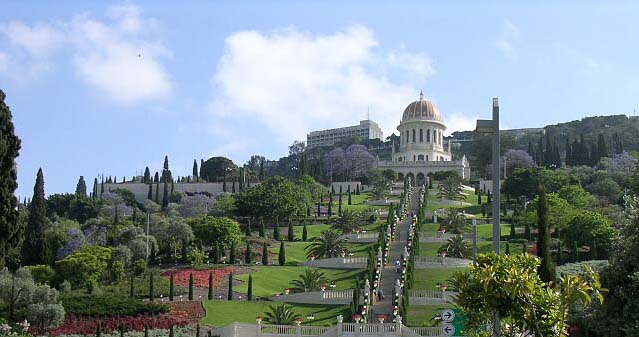
The two most well-known Bahá’í shrines serve as the resting places for the respective remains of the two central figures of the Bahá’í Faith, the Báb and Bahá’u’lláh. They are the focal points of a Bahá’í pilgrimage:

Other sites have been designated as Bahá’í Shrines, the most notable being the home of W. S. and May Bolles Maxwell in Montreal, Quebec, Canada.[24]

Druze

.

Buddhism

Buddhist shrine just outside Wat Phnom

In Buddhism, a shrine refers to a place where veneration is focused on the Buddha or one of the bodhisattvas. Monks, nuns and laypeople all give offerings to these revered figures at these shrines and also meditate in front of them.

Typically, Buddhist shrines contain a statue of either the Buddha, or (in the Mahayana and Vajrayana forms of Buddhism), one of the various bodhisattvas.[25] They also commonly contain candles, along with offerings such as flowers, purified water, food, and incense. Many shrines also contain sacred relics, such as the alleged tooth of the Buddha held at a shrine in Sri Lanka.

Site-specific shrines in Buddhism, particularly those that contain relics of deceased buddhas and revered monks, are often designed in the traditional form known as the stupa.

Germanic paganism

In Germanic paganism, types of shrines were employed, but terms for the shrines show some level of ambiguity:

  • Hörgrs, which may have originally exclusively referred to “holy places”, whereas its Old English cognate hearg could mean “holy grove” and/or “temple, idol”[26]
  • Vés (Old Norse) or wēohs (Old English), referring to either a types of shrines or sacred enclosures. The term appears in skaldic poetry and in place names in Scandinavia (with the exception of Iceland), often in connection with a Norse deity or a geographic feature. The name of the Norse god Vé, refers to the practice.[27]

Hinduism

A sanyasi performing Vyasa puja traditionally held on Guru Purnima day, as a part of Chaturmas rituals with shrine of Vyasa Guru at the center

In Hinduism, a shrine is a place where a god or goddess is worshipped. Shrines are typically located inside a temple known as a mandir, though many Hindus also have a household shrine as well. Sometimes a human is venerated at a Hindu shrine along with a deity, for instance the 19th century religious teacher Sri Ramakrishna is venerated at the Ramakrishna Temple in Kolkata, India.

Central to a Hindu shrine is a statue of a deity, which is known as a murti. Hindus believe that the deity that they are worshiping actually enters and inhabits the murti. This is given offerings like candles, food, flowers, and incense. In some cases, particularly among devotees of the goddess Kālī in northern India, animals are sacrificed to the deity.

At a mandir, the congregation often assembles in front of a shrine, and, led by priests, give offerings and sing devotional hymns.

Taoism

The line between a temple and a shrine in Taoism is not fully defined; shrines are usually smaller versions of larger Taoist temples or small places in a home where a yin-yang emblem is placed among peaceful settings to encourage meditation and study of Taoist texts and principles. Taoists place less emphasis on formalized attendance and ritualized worship than other Asian religions; formal temples and structures of worship came about in Taoism mostly in order to prevent losing adherents to Buddhism.[28] Frequent features of Taoist shrines include the same features as full temples, often including any or all of the following features : gardens, running water or fountains, small burning braziers or candles (with or without incense), and copies of Taoist texts such as the Tao Te Ching, Zhuangzi or other texts by Lao Tzu, Chuang Tzu or other Taoist sages.

As with all Taoist worship, Taoist shrines are organized around a sense of appreciation of nature and surroundings that inspire meditation on, and living in accordance with, the Tao (“Way” or “Path”, a concept of living harmoniously with one’s natural surroundings and environment) and the Three Jewels Of Taoism (different from Buddhism’s concept of Three Jewels) – compassion, moderation, and humility.

Secular shrines

In the United States and some other countries, landmarks may be called “historic shrines.” Notable shrines of this type include:

Halls of fame also serve as shrines into which single or multiple individuals are inducted on the basis of their influence upon regions, cultures or disciplines. Busts or full-body statues are often erected and placed alongside each other in commemoration.

By extension the term shrine has come to mean any place dedicated completely to a particular person or subject such as the Shrine of the Sun in Colorado Springs, Colorado.“Will Rogers Shrine of the Sun”. Artsopolis Network. Retrieved December 30, 2011.

See also

Canticle of the Sun

The “Canticle of the Sun”, also known as the “Canticle of the Creatures” or “Laudes Creaturarum” (“Praise of the Creatures”), is a religious song composed by Saint Francis of Assisi. It was written in the Umbrian dialect of Italian but has since been translated into many languages. It is believed to be among the first works of literature, if not the first, written in the Italian language.[1]

Saint Francis of Assisi in Ecstasy
an oil painting by Jusepe de Ribera (1642)


The “Canticle of the Sun” in its praise of God thanks Him for such creations as “Brother Fire” and “Sister Water”. It is an affirmation of Francis’ personal theology as he often referred to animals as brothers and sisters to Mankind, rejected material accumulation and sensual comforts in favor of “Lady Poverty”.

Saint Francis is said to have composed most of the canticle in late 1224 while recovering from an illness at San Damiano, in a small cottage that had been built for him by Saint Clare and other women of her order. According to tradition, the first time it was sung in its entirety was by Francis and Brothers Angelo and Leo, two of his original companions, on Francis’ deathbed, the final verse praising “Sister Death” having been added only a few minutes before.

A legend which emphasizes the topos of “brightness” says he did not write himself the Canticle because of his blindness from an eye disease, but he dictated it and he did it looking at Nature through the eye of mind.

Father Eric Doyle[2] wrote: “Though physically blind, he was able to see more clearly than ever with the inner eye of his mind. With unparalleled clarity he perceived the basic unity of all creation and his own place as a friar in the midst of God’s creatures. His unqualified love of all creatures, great and small, had grown into unity in his own heart. He was so open to reality that it found a place to be at home in his heart and he was at home everywhere and anywhere. He was a centre of communion with all creatures”.[3]

Historically, the “Canticle of the Sun” is first mentioned in the Vita Prima of Thomas of Celano, in 1228.

Text and translation

Original text in Umbrian dialect:

Altissimu, onnipotente bon Signore,
Tue so le laude, la gloria e l’honore et onne benedictione.

Ad Te solo, Altissimo, se konfano,
et nullu homo ène dignu te mentouare.

Laudato sie, mi Signore cum tucte le Tue creature,
spetialmente messor lo frate Sole,
lo qual è iorno, et allumini noi per lui.
Et ellu è bellu e radiante cum grande splendore:
de Te, Altissimo, porta significatione.

Laudato si, mi Signore, per sora Luna e le stelle:
in celu l’ài formate clarite et pretiose et belle.

Laudato si, mi Signore, per frate Uento
et per aere et nubilo et sereno et onne tempo,
per lo quale, a le Tue creature dài sustentamento.

Laudato si, mi Signore, per sor’Acqua,
la quale è multo utile et humile et pretiosa et casta.

Laudato si, mi Signore, per frate Focu,
per lo quale ennallumini la nocte:
ed ello è bello et iucundo et robustoso et forte.

Laudato si, mi Signore, per sora nostra matre Terra,
la quale ne sustenta et gouerna,
et produce diuersi fructi con coloriti fior et herba.

Laudato si, mi Signore, per quelli ke perdonano per lo Tuo amore
et sostengono infirmitate et tribulatione.

Beati quelli ke ‘l sosterranno in pace,
ka da Te, Altissimo, sirano incoronati.

Laudato si mi Signore, per sora nostra Morte corporale,
da la quale nullu homo uiuente pò skappare:
guai a quelli ke morrano ne le peccata mortali;
beati quelli ke trouarà ne le Tue sanctissime uoluntati,
ka la morte secunda no ‘l farrà male.

Laudate et benedicete mi Signore et rengratiate
e seruiteli cum grande humilitate.

Notes: so=sono, si=sii (you are), mi=mio, ka=perché, u replaces v, sirano=saranno

English Translation:

Most high, all powerful, all good Lord!
All praise is Yours, all glory, all honor, and all blessing.

To You, alone, Most High, do they belong.
No mortal lips are worthy to pronounce Your name.

Be praised, my Lord, through all Your creatures,
especially through my lord Brother Sun,
who brings the day; and You give light through him.
And he is beautiful and radiant in all his splendor!
Of You, Most High, he bears the likeness.

Be praised, my Lord, through Sister Moon and the stars;
in the heavens You have made them bright, precious and beautiful.

Be praised, my Lord, through Brothers Wind and Air,
and clouds and storms, and all the weather,
through which You give Your creatures sustenance.

Be praised, my Lord, through Sister Water;
she is very useful, and humble, and precious, and pure.

Be praised, my Lord, through Brother Fire,
through whom You brighten the night.
He is beautiful and cheerful, and powerful and strong.

Be praised, my Lord, through our sister Mother Earth,
who feeds us and rules us,
and produces various fruits with colored flowers and herbs.

Be praised, my Lord, through those who forgive for love of You;
through those who endure sickness and trial.

Happy those who endure in peace,
for by You, Most High, they will be crowned.

Be praised, my Lord, through our sister Bodily Death,
from whose embrace no living person can escape.
Woe to those who die in mortal sin!
Happy those she finds doing Your most holy will.
The second death can do no harm to them.

Praise and bless my Lord, and give thanks,
and serve Him with great humility.

Alternative versions

Hermann Suter composed an oratorio Le Laudi on the Italian words, premiered in 1924.

The American composer Amy Beach (1867–1944) set the Canticle to music for organ or orchestra, choir, and solo vocal quartet, in 1924. The piece was first performed with organ in 1928 at St. Bartholomew’s in New York. The orchestral version was first performed by the Chicago Symphony and the Toledo Choral Society in 1930.

Leo Sowerby (1895–1968) set Matthew Arnold’s English translation of the Canticle for chorus and orchestra in 1945 (The Canticle of the Sun); the work was awarded the Pulitzer Prize for Music the following year.

Charles Martin Loeffler (1861–1935) set a modern Italian translation of the original Umbrian dialect text for soloists and chamber orchestra ca. 1929 which was performed in the same 1945 Carnegie Hall concert as Sowerby’s setting.

Franz Liszt (1811–1886) composed several pieces titled “Cantico del sol di Francesco d’Assisi” with versions for solo piano and orchestra.

Roy Harris (1898–1979) composed a setting for soloists and a large ensemble in 1961. Seth Bingham (1882–1972) made a setting in 1962.

Another setting of the “Canticle of the Sun”, titled Cantico del sole was composed by William Walton (1902–1983) in 1974 for the Cork International Choral Festival.

Russian composer Sofia Gubaidulina wrote a piece dedicated to cellist Mstislav Rostropovich for his seventieth birthday.

A modern rendition was used in the musical biography of Saint Francis, Brother Sun, Sister Moon.

The acclaimed Spanish composer, Joaquín Rodrigo, composed a piece to the words in Spanish of the Canticle, for choir and orchestra in 1982: Cantico de San Francisco de Asis.

Perhaps the best-known version in English is the hymn “All Creatures of Our God and King” which contains a paraphrase of Saint Francis’ song by William H. Draper (1855–1933). Draper set the words to the 17th-century German hymn tune “Lasst Uns Erfreuen”, for use at a children’s choir festival some time between 1899 and 1919.[4]

The lines “Brother Sun” and “Sister Moon” inspired the album Brother, Sister by indie rock band mewithoutYou.

The song “Brother Moon” by Gungor on the album Ghosts Upon the Earth was inspired by the Canticle.

Laudes Creaturarum has also been set to music by German composer Carl Orff.

The Italian folk singer Angelo Branduardi composed a ballad entitled “Il cantico delle creature” in year 2000 based on the original lyrics of the Canticle.

See also

References

External links

Prayer

From Wikipedia, the free encyclopedia

Mary Magdalene by Ary Scheffer (1795–1858).

Prayer is an invocation or act that seeks to activate a rapport with a deity, an object of worship, or a spiritual entity through deliberate communication. Prayer can be a form of religious practice, may be either individual or communal and take place in public or in private. It may involve the use of words or song. When language is used, prayer may take the form of a hymn, incantation, formal creed, or a spontaneous utterance in the praying person. There are different forms of prayer such as petitionary prayer, prayers of supplication, thanksgiving, and worship/praise. Prayer may be directed towards a deity, spirit, deceased person, or lofty idea, for the purpose of worshipping, requesting guidance, requesting assistance, confessing sins or to express one’s thoughts and emotions. Thus, people pray for many reasons such as personal benefit or for the sake of others.

Most major religions involve prayer in one way or another. Some ritualize the act of prayer, requiring a strict sequence of actions or placing a restriction on who is permitted to pray, while others teach that prayer may be practiced spontaneously by anyone at any time.

Scientific studies regarding the use of prayer have mostly concentrated on its effect on the healing of sick or injured people. Meta-studies of the studies in this field have been performed showing evidence only for no effect or a potentially small effect. For instance, a 2006 meta analysis on 14 studies concluded that there is “no discernable effect” while a 2007 systemic review of intercessory prayer reported inconclusive results, noting that 7 of 17 studies had “small, but significant, effect sizes” but the review noted that the most methodologically rigorous studies failed to produce significant findings.[1][2] Some studies have indicated increased medical complications in groups receiving prayer over those without.[3][4][5] The efficacy of petition in prayer for physical healing to a deity has been evaluated in numerous other studies, with contradictory results.[6][7][8][9] There has been some criticism of the way the studies were conducted.[3][10]

Forms of prayer

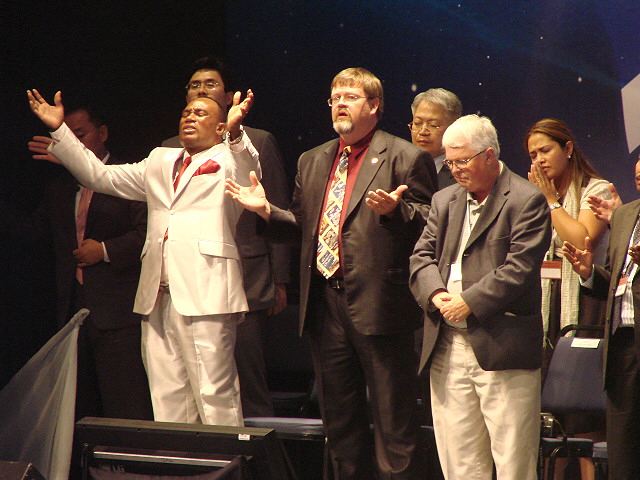
Christians at prayer

Muslim men prostrating during prayer in a mosque.

The act of prayer is attested in written sources as early as 5000 years ago.[11] Some anthropologists, such as Sir Edward Burnett Tylor and Sir James George Frazer, believed that the earliest intelligent modern humans practiced something that we would recognize today as prayer.[12]

Various spiritual traditions offer a wide variety of devotional acts. There are morning and evening prayers, graces said over meals, and reverent physical gestures. Some Christians bow their heads and fold their hands. Some Native Americans regard dancing as a form of prayer.[13] Some Sufis whirl.[14] Hindus chant mantras.[15] Jewish prayer may involve swaying back and forth and bowing.[16] Muslims practice salat (kneeling and prostration) in their prayers. Quakers keep silent.[17] Some pray according to standardized rituals and liturgies, while others prefer extemporaneous prayers. Still others combine the two.

Friedrich Heiler is often cited in Christian circles for his systematic Typology of Prayer which lists six types of prayer: primitive, ritual, Greek cultural, philosophical, mystical, and prophetic.[18]

The act of worship

See also: Worship

Prayer has many different forms. Prayer may be done privately and individually, or it may be done corporately in the presence of fellow believers. Prayer can be incorporated into a daily “thought life”, in which one is in constant communication with a god. Some people pray throughout all that is happening during the day and seek guidance as the day progresses. This is actually regarded as a requirement in several Christian denominations,[19] although enforcement is not possible nor desirable. There can be many different answers to prayer, just as there are many ways to interpret an answer to a question, if there in fact comes an answer.[19] Some may experience audible, physical, or mental epiphanies. If indeed an answer comes, the time and place it comes is considered random. Some outward acts that sometimes accompany prayer are: anointing with oil;[20] ringing a bell;[21] burning incense or paper;[22] lighting a candle or candles;[23] facing a specific direction (i.e. towards Mecca[24] or the East); making the sign of the cross. One less noticeable act related to prayer is fasting.

A variety of body postures may be assumed, often with specific meaning (mainly respect or adoration) associated with them: standing; sitting; kneeling; prostrate on the floor; eyes opened; eyes closed; hands folded or clasped; hands upraised; holding hands with others; a laying on of hands and others. Prayers may be recited from memory, read from a book of prayers, or composed spontaneously as they are prayed. They may be said, chanted, or sung. They may be with musical accompaniment or not. There may be a time of outward silence while prayers are offered mentally. Often, there are prayers to fit specific occasions, such as the blessing of a meal, the birth or death of a loved one, other significant events in the life of a believer, or days of the year that have special religious significance. Details corresponding to specific traditions are outlined below.

Criticism

One criticism of prayer is that if the petitioner is praying to a god which is omnipotent and all-knowing, it would be presumptuous for him or her to believe they understand the grand scheme of things sufficiently to pray for what is best. For example, Christopher Hitchens interprets Ambrose Bierce’s definition of prayer by stating that “the man who prays is the one who thinks that god has arranged matters all wrong, but who also thinks that he can instruct god how to put them right.”[25]

Another criticism is that prayer may relieve a person of the need to take active measures to address issues around them. Daniel Dennett states:

Surely it does the world no harm if those who can honestly do so pray for me! No, I’m not at all sure about that. For one thing, if they really wanted to do something useful, they could devote their prayer time and energy to some pressing project that they can do something about.[26]

This potential drawback manifests in extreme forms in such cases as Christian Scientists who rely on prayers instead of seeking medical treatment for family members for easily curable conditions which later result in death.[27]

Another challenge is that the intent for prayer may be inconsistent between petitioners: for example, one might be striving for an actual intervention while another might use prayer to feel better. In this light, Hitchens questions religious leaders who accept monies along with a prayer: “The leaders of the church know perfectly well that prayer is not intended to gratify the devout. So that, every time they accept a donation in return for some petition, they are accepting a gross negation of their faith: a faith that depends on the passive acceptance of the devout and not on their making demands for betterment.”[25]

Pre-Christian Europe

Etruscan, Greek, and Roman paganism

In the pre-Christian religions of Greeks and Romans (Ancient Greek religion, Roman religion), ceremonial prayer was highly formulaic and ritualized.[28][29] The Iguvine Tables contain a supplication that can be translated, “If anything was said improperly, if anything was done improperly, let it be as if it were done correctly.”

The formalism and formulaic nature of these prayers led them to be written down in language that may have only been partially understood by the writer, and our texts of these prayers may in fact be garbled. Prayers in Etruscan were used in the Roman world by augurs and other oracles long after Etruscan became a dead language. The Carmen Arvale and the Carmen Saliare are two specimens of partially preserved prayers that seem to have been unintelligible to their scribes, and whose language is full of archaisms and difficult passages.[30]

Roman prayers and sacrifices were often envisioned as legal bargains between deity and worshipper. The Roman principle was expressed as do ut des: “I give, so that you may give.” Cato the Elder‘s treatise on agriculture contains many examples of preserved traditional prayers; in one, a farmer addresses the unknown deity of a possibly sacred grove, and sacrifices a pig in order to placate the god or goddess of the place and beseech his or her permission to cut down some trees from the grove.[31]

Germanic paganism

The valkyrie Sigrdrífa says a pagan Norse prayer in Sigrdrífumál. Illustration by Arthur Rackham.

An amount of accounts of prayers to the gods in Germanic paganism survived the process of Christianization, though only a single prayer has survived without the interjection of Christian references. This prayer is recorded in stanzas 2 and 3 of the poem Sigrdrífumál, compiled in the 13th century Poetic Edda from earlier traditional sources, where the valkyrie Sigrdrífa prays to the gods and the earth after being woken by the hero Sigurd.[32]

A prayer to the bigger god Odin is mentioned in chapter 2 of the Völsunga saga where King Rerir prays for a child. His prayer is answered by Frigg, wife of Odin, who sends him an apple, which is dropped on his lap by Frigg’s servant in the form of a crow while Rerir is sitting on a mound. Rerir’s wife eats the apple and is then pregnant with the hero Völsung. In stanza 9 of the poem Oddrúnargrátr, a prayer is made to “kind wights, Frigg and Freyja, and many gods,” although since the poem is often considered one of the youngest poems in the Poetic Edda, the passage has been the matter of some debate.[33]

In chapter 21 of Jómsvíkinga saga, wishing to turn the tide of the Battle of Hjörungavágr, Haakon Sigurdsson eventually finds his prayers answered by the goddesses Þorgerðr Hölgabrúðr and Irpa (the first of the two described as Haakon’s patron goddess) who appear in the battle, kill many of the opposing fleet, and cause the remnants of their forces to flee. However, this depiction of a pagan prayer has been criticized as inaccurate due to the description of Haakon dropping to his knees.[34]

The 11th-century manuscript for the Anglo-Saxon charm Æcerbot presents what is thought to be an originally pagan prayer for the fertility of the speaker’s crops and land, though Christianization is apparent throughout the charm.[35] The 8th-century Wessobrunn Prayer has been proposed as a Christianized pagan prayer and compared to the pagan Völuspá[36] and the Merseburg Incantations, the latter recorded in the 9th or 10th century but of much older traditional origins.[37]

Abrahamic religions

Bible

In the common Bible of the Abrahamic religions, various forms of prayer appear; the most common forms being petition, thanksgiving, and worship. The longest book in the Bible is the Book of Psalms, 150 religious songs which are often regarded as prayers. Other well-known Biblical prayers include the Song of Moses (Exodus 15:1–18), the Song of Hannah (1 Samuel 2:1–10), and the Magnificat (Luke 1:46–55). The most recognized prayers in the Christian Bible are the Lord’s Prayer (Matthew 6:9–13; Luke 11:2–4) and Hail Mary (Luke 1:28; Luke 1:42).

Judaism

Main article: Jewish prayer

Captain Samuel Cass, a rabbi, conducting the first prayer service celebrated on German territory by Jewish personnel of the 1st Canadian Army near Cleve, Germany, 18 March 1945.

Observant Jews pray three times a day, Shacharit, Mincha, and Arvit with lengthier prayers on special days, such as the Shabbat and Jewish holidays including Musaf and the reading of the Torah. The siddur is the prayerbook used by Jews all over the world, containing a set order of daily prayers. Jewish prayer is usually described as having two aspects: kavanah (intention) and keva (the ritualistic, structured elements).

The most important Jewish prayers are the Shema Yisrael (“Hear O Israel”) and the Amidah (“the standing prayer”).

Communal prayer is preferred over solitary prayer, and a quorum of 10 adult males (a minyan) is considered by Orthodox Judaism a prerequisite for several communal prayers.

There are also many other ritualistic prayers a Jew performs during their day, such as washing before eating bread, washing after one wakes up in the morning, and doing grace after meals.

Rationalist approach to prayer

In this view, ultimate goal of prayer is to help train a person to focus on divinity through philosophy and intellectual contemplation. This approach was taken by Maimonides and the other medieval rationalists. One example of this approach to prayer is noted by Rabbi Steven Weil, who was appointed the Orthodox Union’s Executive-Vice President in 2009. He notes that the word “prayer” is a derivative of the Latin “precari”, which means “to beg”. The Hebrew equivalent “tefilah”, however, along with its root “pelel” or its reflexive “l’hitpallel”, means the act of self-analysis or self-evaluation.[38] This approach is sometimes described as the person praying having a dialogue or conversation with God.[39]

Educational approach to prayer

In this view, prayer is not a conversation. Rather, it is meant to inculcate certain attitudes in the one who prays, but not to influence. This has been the approach of Rabbenu Bachya, Yehuda Halevy, Joseph Albo, Samson Raphael Hirsch, and Joseph Dov Soloveitchik. This view is expressed by Rabbi Nosson Scherman in the overview to the Artscroll Siddur (p. XIII); note that Scherman goes on to also affirm the Kabbalistic view (see below).

Kabbalistic approach to prayer

Kabbalah (Jewish mysticism) uses a series of kavanot, directions of intent, to specify the path the prayer ascends in the dialog with God, to increase its chances of being answered favorably. Kabbalists ascribe a higher meaning to the purpose of prayer, which is no less than affecting the very fabric of reality itself, restructuring and repairing the universe in a real fashion. In this view, every word of every prayer, and indeed, even every letter of every word, has a precise meaning and a precise effect. Prayers thus literally affect the mystical forces of the universe, and repair the fabric of creation.[40]

Among Jews, this approach has been taken by the Chassidei Ashkenaz (German pietists of the Middle-Ages), the Arizal’s Kabbalist tradition, Ramchal, most of Hassidism, the Vilna Gaon, and Jacob Emden.

Christianity

Orthodox pilgrim praying in front of icon of Saint Mary in Kiev Pechersk Lavra, Ukraine.

18th-century Byzantine-style bronze panagia from Jerusalem, showing the Virgin Mary in the orans prayer posture.

Christian prayers are quite varied. They can be completely spontaneous, or read entirely from a text, like the Anglican Book of Common Prayer. The most common prayer among Christians is the Lord’s Prayer, which according to the gospel accounts (e.g. Matthew 6:9–13) is how Jesus taught his disciples to pray.[41] The Lord’s prayer is a model for prayers of adoration, confession and petition in Christianity.[41]

Christians generally pray to God or to the Father. Some Christians (e.g., Catholics, Orthodox) will also ask the righteous in heaven and “in Christ,” such as Virgin Mary or other saints to intercede by praying on their behalf (intercession of saints). Formulaic closures include “through our Lord Jesus Christ, Your Son, who lives and reigns with You, in the unity of the Holy Spirit, God, through all the ages of ages,” and “in the name of the Father, and the Son, and the Holy Spirit.”

It is customary among Protestants to end prayers with “In Jesus‘ name, Amen” or “In the name of Christ, Amen.”[42] However, the most commonly used closure in Christianity is simply “Amen” (from a Hebrew adverb used as a statement of affirmation or agreement, usually translated as so be it).

In the Western or Latin Rite of the Catholic Church, probably the most common is the Rosary; In the Eastern Church (the Eastern rites of the Catholic Church and Orthodox Church), the Jesus Prayer. The Jesus Prayer is also often repeated as part of the meditative hesychasm practice in Eastern Christianity.[43]

Roman Catholic tradition includes specific prayers and devotions as acts of reparation which do not involve a petition for a living or deceased beneficiary, but aim to repair the sins of others, e.g. for the repair of the sin of blasphemy performed by others.[44]

Other forms of prayer among Catholics would be meditative prayer, contemplative prayer and infused prayer discussed at length by Catholic Saints St. John of the Cross and St. Theresa of Jesus.

Mormonism

Members of The Church of Jesus Christ of Latter-day Saints believe that each human is a child of God and that God loves and knows all needs, However, Mormons believe that God wants all to communicate with Him through prayer and that God will answer their prayers by using direct revelation to them. Members of the Church do not commonly recite prayers that have been composed and written, except the blessing on the sacrament.

Pentecostalism

In Pentecostal congregations, prayer is often done by speaking in a foreign tongue, a practice now known as glossolalia.[45] Practitioners of Pentecostal glossolalia may claim that the languages they speak in prayer are real foreign languages, and that the ability to speak those languages spontaneously is a gift of the Holy Spirit;[46][47] however, many people outside the movement have offered alternative views. George Barton Cutten suggested that glossolalia was a sign of mental illness.[48] Felicitas Goodman suggested that tongue speakers were under a form of hypnosis.[49] Others suggest that it is a learned behaviour.[50][51] Some of these views have allegedly been refuted.[52][53]

Christian Science

Christian Science teaches that prayer is a spiritualization of thought or an understanding of God and of the nature of the underlying spiritual creation. Adherents believe that this can result in healing, by bringing spiritual reality (the “Kingdom of Heaven” in Biblical terms) into clearer focus in the human scene. The world as it appears to the senses is regarded as a distorted version of the world of spiritual ideas. Prayer can heal the distortion. Christian Scientists believe that prayer does not change the spiritual creation but gives a clearer view of it, and the result appears in the human scene as healing: the human picture adjusts to coincide more nearly with the divine reality.[54] Christian Scientists do not practice intercessory prayer as it is commonly understood, and they generally avoid combining prayer with medical treatment in the belief that the two practices tend to work against each other. (However, the choice of healing method is regarded as a matter for the individual, and the Christian Science Church exerts no pressure on members to avoid medical treatment if they wish to avail of it as an alternative to Christian Science healing.[citation needed]) Prayer works through love: the recognition of God’s creation as spiritual, intact, and inherently lovable.[55]

Prevalence of prayer for health

Some modalities of alternative medicine employ prayer. A survey released in May 2004 by the National Center for Complementary and Alternative Medicine, part of the National Institutes of Health in the United States, found that in 2002, 43% of Americans pray for their own health, 24% pray for others’ health, and 10% participate in a prayer group for their own health.

Islam

Main article: Salat and Dua

Muslim men praying in Afghanistan.

Prayer hall of the Great Mosque of Kairouan (also called Mosque of Uqba) which is situated in the city of Kairouan in Tunisia. At the bottom of the central nave of the prayer hall there is a niche (the mihrab) which indicates the direction of the prayer.

Muslims pray a ritualistic prayer called salat in Arabic, facing the Kaaba in Mecca, five times a day. The command to ritual prayer is in the Quran in several chapters. The prophet Muhammed showed each Muslim the true method of offering ritual prayers thus the same method is observed till date. There is the “call for prayer” (adhan), where the muezzin calls for all the followers to stand together for the ritual prayer. The prayer consists of standing, by mentioning ‘Allāhu akbar’ (Allāh is Great) followed by recitation of the first chapter of the Quran. Afterwards the person bends and praises God, then prostrates themself and again praises God. The prayer ends with the following words: “Peace be with you and God’s mercy”. During the prayer, a Muslim cannot talk or do anything else besides praying. Certain Shia sects combine the 5 prayers into 3 times a day, providing several hadith as supporting evidence.[56]

Once the ritual prayer (salat) is complete, one can offer personal prayers or supplications to God for their needs. These are called dua. There are many standard invocations in Arabic to be recited at various times, e.g. for one’s parents, after salat, before eating. Muslims may also say dua in their own words and languages for any issue they wish to communicate with God in the hope that God will answer their prayers.[24]

Bahá’í

Bahá’u’lláh, the Báb, and `Abdu’l-Bahá have revealed many prayers for general use, and some for specific occasions, including for unity, detachment, spiritual upliftment, and healing among others. Bahá’ís are also required to recite each day one of three obligatory prayers revealed by Bahá’u’lláh. The believers have been enjoined to face in the direction of the Qiblih when reciting their Obligatory Prayer. The longest obligatory prayer may be recited at any time during the day; another, of medium length, is recited once in the morning, once at midday, and once in the evening; and the shortest can be recited anytime between noon and sunset. Bahá’ís also read from and meditate on the scriptures every morning and evening.[57]

Eastern religions

In contrast with Western religion, Eastern religion for the most part discards worship and places devotional emphasis on the practice of meditation alongside scriptural study. Consequently, prayer is seen as a form of meditation or an adjunct practice to meditation.[citation needed]

Buddhism

In certain Buddhist sects, prayer accompanies meditation. Buddhism for the most part sees prayer as a secondary, supportive practice to meditation and scriptural study. Gautama Buddha claimed that human beings possess the capacity and potential to become liberated, or enlightened, through contemplation (Sanskrit: bhāvana and dhyāna), leading to insight. Prayer is seen mainly as a powerful psycho-physical practice that can enhance meditation.[58]

In the earliest Buddhist tradition, the Theravada, and in the later Mahayana tradition of Zen (or Chán), prayer plays only an ancillary role. It is largely a ritual expression of wishes for success in the practice and in helping all beings.[59][60][61][62]

The skillful means (Sanskrit: upāya) of the transfer of merit (Sanskrit: pariṇāmanā) is an evocation and prayer. Moreover, indeterminate buddhas are available for intercession as they reside in awoken-fields (Sanskrit: buddha-kshetra).

The nirmānakāya of an awoken-field is what is generally known and understood as a mandala. The opening and closing of the ring (Sanskrit: maṇḍala) is an active prayer. An active prayer is a mindful activity, an activity in which mindfulness is not just cultivated but is.[63] A common prayer is “May the merit of my practice, adorn Buddhas’ Pure Lands, requite the fourfold kindness from above, and relieve the suffering of the three life-journeys below. Universally wishing sentient beings, Friends, foes, and karmic creditors, all to activate the bodhi mind, and all to be reborn in the Pure Land of Ultimate Bliss.” (願以此功德 莊嚴佛淨土 上報四重恩 下濟三途苦 普願諸眾生 冤親諸債主 悉發菩提心 同生極樂國)[64]

The Generation Stage (Sanskrit: utpatti-krama) of Vajrayana involves prayer elements.[65]

The Tibetan Buddhism tradition emphasizes an instructive and devotional relationship to a guru; this may involve devotional practices known as guru yoga which are congruent with prayer. It also appears that Tibetan Buddhism posits the existence of various deities, but the peak view of the tradition is that the deities or yidam are no more existent or real than the continuity (Sanskrit: santana; refer mindstream) of the practitioner, environment and activity. But how practitioners engage yidam or tutelary deities will depend upon the level or more appropriately yana at which they are practicing. At one level, one may pray to a deity for protection or assistance, taking a more subordinate role. At another level, one may invoke the deity, on a more equal footing. And at a higher level one may deliberately cultivate the idea that one has become the deity, whilst remaining aware that its ultimate nature is śūnyatā. The views of the more esoteric yana are impenetrable for those without direct experience and empowerment.

Pure Land Buddhism emphasizes the recitation by devotees of prayer-like mantras, a practice often called Nembutsu.[66]:190 On one level it is said that reciting these mantras can ensure rebirth into a Sambhogakāya land (Sanskrit: buddha-kshetra) after bodily dissolution, a sheer ball spontaneously co-emergent to a buddha’s enlightened intention. According to Shinran, the founder of the Pure Land Buddhism tradition that is most prevalent in the US,[66]:193[67] “for the long haul nothing is as efficacious as the Nembutsu.”[66]:197[68] On another, the practice is a form of meditation aimed at achieving realization.[citation needed]

But beyond all these practices the Buddha emphasized the primacy of individual practice and experience. He said that supplication to gods or deities was not necessary. Nevertheless, today many lay people in East Asian countries pray to the Buddha in ways that resemble Western prayer—asking for intervention and offering devotion.

Hinduism

Main article: Prayer in Hinduism

Shakta Hindus in Dhaka, Bangladesh, pray to the goddess during Durga Puja, October 2003.

Hinduism has incorporated many kinds of prayer (Sanskrit: prārthanā), from fire-based rituals to philosophical musings. While chanting involves ‘by dictum’ recitation of timeless verses or verses with timings and notations, dhyanam involves deep meditation (however short or long) on the preferred deity/God. Again the object to which prayers are offered could be a persons referred as devtas, trinity or incarnation of either devtas or trinity or simply plain formless meditation as practiced by the ancient sages. All of these are directed to fulfilling personal needs or deep spiritual enlightenment. Ritual invocation was part and parcel of the Vedic religion and as such permeated their sacred texts. Indeed, the highest sacred texts of the Hindus, the Vedas, are a large collection of mantras and prayer rituals. Classical Hinduism came to focus on extolling a single supreme force, Brahman, that is made manifest in several lower forms as the familiar gods of the Hindu pantheon[dubious ]. Hindus in India have numerous devotional movements. Hindus may pray to the highest absolute God Brahman, or more commonly to Its three manifestations namely creator god called Brahma, preserver god called Vishnu and destroyer god (so that the creation cycle can start afresh) Shiva, and at the next level to Vishnu’s avatars (earthly appearances) Rama and Krishna or to many other male or female deities. Typically, Hindus pray with their hands (the palms) joined together in pranam.[69] The hand gesture is similar to the popular Indian greeting namaste.

Jainism

Although Jainism believes that no spirit or divine being can assist them on their path, these figures do hold some influence on believers, and on special occasions, Jains will pray for right knowledge to the twenty-four Tirthankaras or sometimes to deities such as Ganesha or protectors such as the Yakshas and Yakshinis.

Shinto

Main articles: Shinto and Ema (Shintō)

A man praying at a Japanese Shinto shrine.

The practices involved in Shinto prayer are heavily influenced by Buddhism; Japanese Buddhism has also been strongly influenced by Shinto in turn. The most common and basic form of devotion involves throwing a coin, or several, into a collection box, ringing a bell, clapping one’s hands, and contemplating one’s wish or prayer silently. The bell and hand clapping are meant to wake up or attract the attention of the kami of the shrine, so that one’s prayer may be heard.

Shinto prayers quite frequently consist of wishes or favors asked of the kami, rather than lengthy praises or devotions. Unlike in certain other faiths, it is not considered irregular or inappropriate to ask favors of the kami in this way, and indeed many shrines are associated with particular favors, such as success on exams.

In addition, one may write one’s wish on a small wooden tablet, called an ema, and leave it hanging at the shrine, where the kami can read it. If the wish is granted, one may return to the shrine to leave another ema as an act of thanksgiving.

Sikhism

A Sikh holy man, doing Sikh Prayer (Ardās)

The Ardās (Punjabi: ਅਰਦਾਸ) is a Sikh prayer that is done before performing or after undertaking any significant task; after reciting the daily Banis (prayers); or completion of a service like the Paath (scripture reading/recitation), kirtan (hymn-singing) program or any other religious program. In Sikhism, these prayers are also said before and after eating. The prayer is a plea to God to support and help the devotee with whatever he or she is about to undertake or has done.

The Ardas is usually always done standing up with folded hands. The beginning of the Ardas is strictly set by the tenth Sikh Guru, Guru Gobind Singh. When it comes to conclusion of this prayer, the devotee uses words like “Waheguru please bless me in the task that I am about to undertake” when starting a new task or “Akal Purakh, having completed the hymn-singing, we ask for your continued blessings so that we can continue with your memory and remember you at all times”, etc. The word “Ardās” is derived from Persian word ‘Arazdashat’, meaning a request, supplication, prayer, petition or an address to a superior authority.

Ardās is a unique prayer based on the fact that it is one of the few well-known prayers in the Sikh religion that was not written in its entirety by the Gurus. The Ardās cannot be found within the pages of the Guru Granth Sahib because it is a continually changing devotional text that has evolved over time in order for it to encompass the feats, accomplishments, and feelings of all generations of Sikhs within its lines. Taking the various derivation of the word Ardās into account, the basic purpose of this prayer is an appeal to Waheguru for his protection and care, as well as being a plea for the welfare and prosperity of all mankind, and a means for the Sikhs to thank Waheguru for all that he has done.[70]

Taoism

Taoism in its earliest form, before being influenced by the arrival of Buddhism in China, was a philosophy rather than a religion. In Taoism there is no deity to pray to, there is only the Tao. In practice Taoists seek to connect with, become one with and embody the Tao in everyday life. This often involves meditative practices including martial, healing and other arts such as Fulu, which is the drawing and writing of supernatural talismans.[71][72]

Taoism is often blended with other practices such as ancestor worship, which can give rise to prayer directed at the ancestors or other deceased historical figures.

Other religions

Wicca

Wiccan prayers can include meditation, rituals and incantations. Prayers are seen as a form of communication with the God and Goddess. This may include prayers for esbat and sabbat celebrations, for dinner, for pre-dawn times or for your own or others safety, for healing or for the dead.[73]

Raelism

In Raelism rites and practises vary from initiation ceremonies, to sensual meditation. An initiation ceremony usually involves a Raelian putting water on the forehead of a new member. Such ceremonies are performed on certain special days on the Raelian calendar.[74] Sensual meditation techniques include breathing exercises and various forms of erotic meditation.[75]

Eckankar

In Eckankar, one of the basic forms of prayer includes singing the word “HU” which is pronounced as “hue”, a holy name of God. This can be done with eyes closed or open, aloud or silently. Practitioners may experience the divine ECK or Holy Spirit.[76]

Animism

Main articles: Animism and Shamanism

Although prayer in its literal sense is not used in animism, communication with the spirit world is vital to the animist way of life. This is usually accomplished through a shaman who, through a trance, gains access to the spirit world and then shows the spirits’ thoughts to the people. Other ways to receive messages from the spirits include using astrology or contemplating fortune tellers and healers.[77] The native religions in some parts of North, East and South Asia, America, Africa, and Oceania are often animistic.

Americas

Main article: Aztec religion

The Aztec religion was not strictly animist. It had an ever increasing pantheon of deities, and the shamans performed ritual prayer to these deities in their respective temples. These shamans made petitions to the proper deities in exchange for a sacrifice offering: food, flowers, effigies, and animals, usually quail. But the larger the thing required from the God the larger the sacrifice had to be, and for the most important rites one would offer one’s own blood; by cutting his ears, arms, tongue, thighs, chest or genitals, and often a human life; either warrior, slave, or even self-sacrifice.[78]

The Pueblo Indians are known to have used prayer sticks, that is, sticks with feathers attached as supplicatory offerings. The Hopi Indians used prayer sticks as well, but they attached to it a small bag of sacred meal.[79]

Australia

In Australia, prayers to the “Great Wit” are performed by the “clever wapmen” and “clever women”, or kadji. These Aboriginal shamans use maban or mabain, the material that is believed to give them their purported magical powers.[80]

Neopaganism

Adherents to forms of modern Neopaganism pray to various gods. The most commonly worshiped and prayed to gods are those of Pre-Christian Europe, such as Celtic, Norse, or Graeco-Roman gods. Prayer can vary from sect to sect, and with some (such as Wicca) prayer may also be associated with ritual magick.

Theurgy and Western esotericism

Practitioners of theurgy and western esotericism may practice a form of ritual which utilizes both pre-sanctioned prayers and names of God, and prayers “from the heart” that, when combined, allows the participant to ascend spiritually, and in some instances, induce a trance in which God or other spiritual beings may be realized. Very similar to hermetic qabala, and orthodox qabala, it is believed that prayer can influence both the physical and non-physical worlds. The use of ritualistic signs and names are believed to be archetypes in which the subconscious may take form as the Inner God, or another spiritual being, and the “prayer from the heart” to be that spiritual force speaking through the participant.

Thelema

Many Thelemites recite “Resh” (Liber Resh vel Helios, or “Liber CC”) facing the direction of the ever present sun as it rises in the East, triumphs in the South, sets in the West, and “hides” in the North. Photo shows a close-up of the Stele of Revealing .

In Thelema (a religion or system of philosophy[81] that includes both theist as well as atheist practitioners) adherents share a number of practices that are forms of individual prayer, including basic yoga; (asana and pranayama); various forms of ritual magick; rituals of one’s own devising (often based upon a syncretism of religions, or Western Esotericism, such as the Lesser Banishing Ritual of the Pentagram and Star Ruby); and performance of Liber Resh vel Helios (aka Liber 200), which consists of four daily adorations to the sun (often consisting of 4 hand/body positions and recitation of a memorized song, normally spoken, addressing different godforms identified with the sun).[82] While there is no dogma within Thelema that expresses the purpose behind any individual aspirant who chooses to perform “Resh”, it may be noted that the practice of “Resh” is not a simple petition toward the sun, nor a form of “worshiping” the celestial body that we call the Sun, but instead uses the positioning of that source of light, which enables life on our planet, as well as uses mythological images of that solar force, so that the individual can perform the prayer, possibly furthering a self-identification with the sun, so “that repeated application of the Liber Resh adorations expands the consciousness of the individual by compelling him to take a different perspective, by inducing him to ‘look at things from the point of view of the Sun’[83]

Approaches to prayer

Praying Hands by Albrecht Dürer showing the hand position of a medieval commendation ceremony.

Direct petitions to God

From Biblical times to today, the most common form of prayer is to directly appeal to God to grant one’s requests. This in many ways is the simplest form of prayer. Some have termed this the social approach to prayer.[84] In this view, a person directly enters into God’s rest, and asks for their needs to be fulfilled. God listens to the prayer, and may so or not choose to answer in the way one asks of him. This is the primary approach to prayer found in the Hebrew Bible, the New Testament, most of the Church writings, and in rabbinic literature such as the Talmud.

Educational approach

In this view, prayer is not a conversation. Rather, it is meant to inculcate certain attitudes in the one who prays, but not to influence. Among Jews, this has been the approach of Rabbenu Bachya, Rabbi Yehuda Halevi, Joseph Albo, Samson Raphael Hirsch, and Joseph B. Soloveitchik. This view is expressed by Rabbi Nosson Scherman in the overview to the Artscroll Siddur (p. XIII).

Among Christian theologians, E.M. Bounds stated the educational purpose of prayer in every chapter of his book, The Necessity of Prayer. Prayer books such as the Book of Common Prayer are both a result of this approach and an exhortation to keep it.[85]

Rationalist approach

In this view, the ultimate goal of prayer is to help train a person to focus on divinity through philosophy and intellectual contemplation. This approach was taken by the Jewish scholar and philosopher Maimonides and the other medieval rationalists; it became popular in Jewish, Christian, and Islamic intellectual circles, but never became the most popular understanding of prayer among the laity in any of these faiths. In all three of these faiths today, a significant minority of people still hold to this approach.

Experiential approach

In this approach, the purpose of prayer is to enable the person praying to gain a direct experience of the recipient of the prayer (or as close to direct as a specific theology permits). This approach is very significant in Christianity and widespread in Judaism (although less popular theologically). In Eastern Orthodoxy, this approach is known as hesychasm. It is also widespread in Sufi Islam, and in some forms of mysticism. It has some similarities with the rationalist approach, since it can also involve contemplation, although the contemplation is not generally viewed as being as rational or intellectual. Christian and Roman Catholic traditions also include an experiential approach to prayer within the practice of Lectio Divina, historically a Benedictine practice in which scripture is read aloud; actively meditated upon using the intellect (but not analysis) possibly using the mind to place the listener within a relationship or dialogue with the text that was read; a prayer spoken; and finally concludes with contemplation, a more passive experiential approach than the previous meditation, which is characterized by the Catechism of the Catholic Church as an experience of consciously being attentive, and having a silent love toward God, which the individual experiences without demanding to receive an experience.[86] The experience of God within Christian mysticism has been contrasted with the concept of experiential religion or mystical experience because of a long history or authors living and writing about experience with the divine in a manner that identifies God as unknowable and ineffable, the language of such ideas could be characterized paradoxically as “experiential”, as well as without the phenomena of experience.[87]

Origins of an idea of Prayer as “Experiential”

The notion of “religious experience” can be traced back to William James, who used a term called “religious experience” in his book, The Varieties of Religious Experience.[88] The origins of the use of this term can be dated further back.

In the 18th, 19th, and 20th centuries, several historical figures put forth very influential views that religion and its beliefs can be grounded in experience itself. While Kant held that moral experience justified religious beliefs, John Wesley in addition to stressing individual moral exertion thought that the religious experiences in the Methodist movement (paralleling the Romantic Movement) were foundational to religious commitment as a way of life.[89]

Wayne Proudfoot traces the roots of the notion of “religious experience” to the German theologian Friedrich Schleiermacher (1768–1834), who argued that religion is based on a feeling of the infinite. The notion of “religious experience” was used by Schleiermacher and Albert Ritschl to defend religion against the growing scientific and secular critique, and defend the view that human (moral and religious) experience justifies religious beliefs.

Such religious empiricism would be later seen as highly problematic and was — during the period in-between world wars — famously rejected by Karl Barth.[90] In the 20th century, religious as well as moral experience as justification for religious beliefs still holds sway. Some influential modern scholars holding this liberal theological view are Charles Raven and the Oxford physicist/theologian Charles Coulson.[91]

The notion of “religious experience” was adopted by many scholars of religion, of which William James was the most influential.[92][note 1]

General Criticism arising from the concept of “Experiential Prayer”

The notion of “experience” has been criticised.[97][98][99] Robert Sharf points out that “experience” is a typical Western term, which has found its way into Asian religiosity via western influences.[97][note 2] The notion of “experience” introduces a false notion of duality between “experiencer” and “experienced”, whereas the essence of kensho is the realisation of the “non-duality” of observer and observed.[101][102] “Pure experience” does not exist; all experience is mediated by intellectual and cognitive activity.[103][104] The specific teachings and practices of a specific tradition may even determine what “experience” someone has, which means that this “experience” is not the proof of the teaching, but a result of the teaching.[105] A pure consciousness without concepts, reached by “cleaning the doors of perception”,[note 3] would be an overwhelming chaos of sensory input without coherence.[107]

Transformative approach

In this approach, prayer enables an existential transformation in the person praying. The act of praying elicits a new kind of understanding which wasn’t apparent before praying. The Danish philosopher Søren Kierkegaard wrote that “the function of prayer is not to influence God, but rather to change the nature of the one who prays.”

Prayer groups

A prayer group is a group of people that meet to pray together. These groups, formed mostly within Christian congregations but occasionally among Muslim groups as well,[108] gather outside of the congregation’s regular worship service to pray for perceived needs, sometimes within the congregation, sometimes within their religious group at large. However, these groups often pray also for the world around them, including people who do not share their beliefs.

Many prayer group meetings are held according to a regular schedule, usually once a week. However, extraordinary events, such as the September 11 attacks[109] or major disasters spawned a number of improvised prayer group meetings. Prayer groups do not need to meet in person, and there are a vast array of single-purpose prayer groups in the world.

Prayer requests

A prayer request is a religious practice in which personal requests for others, including organized prayer groups, to pray on behalf of the requester for any specific reasons. Requests are often collected in order to act upon them either as an organized prayer gathering or as individuals.

Prayer healing

Main article: Faith healing

Prayer is often used as a means of faith healing in an attempt to use religious or spiritual means to prevent illness, cure disease, or improve health. Some attempt to heal by prayer, mental practices, spiritual insights, or other techniques, claiming they can summon divine or supernatural intervention on behalf of the ill. Others advocate that ill people may achieve healing through prayer performed by themselves.[110] According to the varied beliefs of those who practice it, faith healing may be said to afford gradual relief from pain or sickness or to bring about a sudden “miracle cure”, and it may be used in place of, or in tandem with, conventional medical techniques for alleviating or curing diseases. Faith healing has been criticized on the grounds that those who use it may delay seeking potentially curative conventional medical care. This is particularly problematic when parents use faith healing techniques on children.

Efficacy of prayer healing

Main article: Efficacy of prayer

A praying man by Vittore Carpaccio

In 1872, Francis Galton conducted a famous statistical experiment to determine whether prayer had a physical effect on the external environment. Galton hypothesized that if prayer was effective, members of the British Royal family would live longer, given that thousands prayed for their wellbeing every Sunday. He therefore compared longevity in the British Royal family with that of the general population, and found no difference.[6] While the experiment was probably intended to satirize, and suffered from a number of confounders, it set the precedent for a number of different studies, the results of which are contradictory.

Two studies claimed that patients who are being prayed for recover more quickly or more frequently although critics have claimed that the methodology of such studies are flawed, and the perceived effect disappears when controls are tightened.[111] One such study, with a double-blind design and about 500 subjects per group, was published in 1988; it suggested that intercessory prayer by born again Christians had a statistically significant positive effect on a coronary care unit population.[7] Critics contend that there were severe methodological problems with this study.[10] Another such study was reported by Harris et al.[8] Critics also claim that the 1988 study was not fully double-blinded, and that in the Harris study, patients actually had a longer hospital stay in the prayer group, if one discounts the patients in both groups who left before prayers began,[112] although the Harris study did demonstrate the prayed for patients on average received lower course scores (indicating better recovery).

One of the largest randomized, blind clinical trials was a remote retroactive intercessory prayer study conducted in Israel by Leibovici. This study used 3393 patient records from 1990–96, and blindly assigned some of these to an intercessory prayer group. The prayer group had shorter hospital stays and duration of fever.[113]

Several studies of prayer effectiveness have yielded null results.[9] A 2001 double-blind study of the Mayo Clinic found no significant difference in the recovery rates between people who were (unbeknownst to them) assigned to a group that prayed for them and those who were not.[114] Similarly, the MANTRA study conducted by Duke University found no differences in outcome of cardiac procedures as a result of prayer.[115] In another similar study published in the American Heart Journal in 2006,[116] Christian intercessory prayer when reading a scripted prayer was found to have no effect on the recovery of heart surgery patients; however, the study found patients who had knowledge of receiving prayer had slightly higher instances of complications than those who did not know if they were being prayed for or those who did not receive prayer.[3][4] Another 2006 study suggested that prayer actually had a significant negative effect on the recovery of cardiac bypass patients, resulting in more frequent deaths and slower recovery time for those patient who received prayers.[5]

Many believe that prayer can aid in recovery, not due to divine influence but due to psychological and physical benefits. It has also been suggested that if a person knows that he or she is being prayed for it can be uplifting and increase morale, thus aiding recovery. (See Subject-expectancy effect.) Many studies have suggested that prayer can reduce physical stress, regardless of the god or gods a person prays to, and this may be true for many worldly reasons. According to a study by Centra State Hospital, “the psychological benefits of prayer may help reduce stress and anxiety, promote a more positive outlook, and strengthen the will to live.”[117] Other practices such as yoga, t’ai chi, and meditation may also have a positive impact on physical and psychological health.

Others feel that the concept of conducting prayer experiments reflects a misunderstanding of the purpose of prayer. The previously mentioned American Heart Journal study published in the American Heart Journal indicated that some of the intercessors who took part in it complained about the scripted nature of the prayers that were imposed to them,[3] saying that this is not the way they usually conduct prayer:

Prior to the start of this study, intercessors reported that they usually receive information about the patient’s age, gender and progress reports on their medical condition; converse with family members or the patient (not by fax from a third party); use individualized prayers of their own choosing; and pray for a variable time period based on patient or family request.

One scientific movement attempts to track the physical effects of prayer through neuroscience. Leaders in this movement include Andrew Newberg, an Associate Professor at the University of Pennsylvania. In Newberg’s brain scans, monks, priests, nuns and gurus alike have exceptionally focused attention and compassion sites. This is a result of the frontal lobe of the brain’s engagement (Newberg, 2009). Newburg believes that anybody can connect to the supernatural with practice. Those without religious affiliations benefit from the connection to the metaphysical as well. Newberg also states that further evidence towards humans’ need for metaphysical relationships is that as science had increased spirituality has not decreased. Newburg believes that at the end of the 18th century, when the scientific method began to consume[page needed] the human mind, religion could have vanished. However, two hundred years later, the perception of spirituality, in many instances, appears to be gaining in strength (2009). Newberg’s research also provides the connection between prayer and meditation and health. By understanding how the brain works during religious experiences and practices Newberg’s research shows that the brain changes during these practices allowing an understanding of how religion affects psychological and physical health (2009). For example, brain activity during meditation indicates that people who frequently practice prayer or meditation experience lower blood-pressure, lower heart rates, decreased anxiety, and decreased depression.[118]

See also

Intuition (psychology)

See also: Insight
The center third of Education (1890), a stained glass window by Louis Comfort Tiffany and Tiffany Studios, located in Linsly-Chittenden Hall at Yale University.

It depicts Science (personified by Devotion, Labor, Truth, Research and Intuition) and Religion (personified by Purity, Faith, Hope, Reverence and Inspiration) in harmony, presided over by the central personification of “Light·Love·Life”.

Intuition is the ability to acquire knowledge without inference or the use of reason.[1] The word intuition comes from Latin verb intueri which is usually translated as to look inside or to contemplate.[2] Intuition is thus often conceived as a kind of inner perception, sometimes regarded as real lucidity or understanding. Cases of intuition are of a great diversity; however, processes by which they happen typically remain mostly unknown to the thinker, as opposed to the view of rational thinking.

Intuition provides views, understandings, judgements, or beliefs that we cannot in every case empirically verify or rationally justify. For this reason, it has been not only a subject of study in psychology, but also a topic of interest in various religions and esoteric domains, as well as a common subject of writings.[3] The right brain is popularly associated with intuitive processes such as aesthetic or generally creative abilities.[4][5][6] Some scientists have contended that intuition is associated with innovation in scientific discovery.[7]

In Jungian psychology

In Carl Jung‘s theory of the ego, described in 1916 in Psychological Types, intuition was an “irrational function”, opposed most directly by sensation, and opposed less strongly by the “rational functions” of thinking and feeling. Jung defined intuition as “perception via the unconscious”: using sense-perception only as a starting point, to bring forth ideas, images, possibilities, ways out of a blocked situation, by a process that is mostly unconscious.

Jung said that a person in whom intuition was dominant, an “intuitive type”, acted not on the basis of rational judgment but on sheer intensity of perception. An extraverted intuitive type, “the natural champion of all minorities with a future”, orients to new and promising but unproven possibilities, often leaving to chase after a new possibility before old ventures have borne fruit, oblivious to his or her own welfare in the constant pursuit of change. An introverted intuitive type orients by images from the unconscious, ever exploring the psychic world of the archetypes, seeking to perceive the meaning of events, but often having no interest in playing a role in those events and not seeing any connection between the contents of the psychic world and him- or herself. Jung thought that extraverted intuitive types were likely entrepreneurs, speculators, cultural revolutionaries, often undone by a desire to escape every situation before it becomes settled and constraining—even repeatedly leaving lovers for the sake of new romantic possibilities. His introverted intuitive types were likely mystics, prophets, or cranks, struggling with a tension between protecting their visions from influence by others and making their ideas comprehensible and reasonably persuasive to others—a necessity for those visions to bear real fruit.[8]

The Myers-Briggs Type Indicator (MBTI), first published in 1944, attempted to provide an empirical method of identifying a person’s dominant ego function, in terms of Carl Jung’s theory. Beginning in the 1960s, scientists performed studies to see if MBTI results were consistent with the assumed theory that Jungian functions exist and conflict in such a way that one of them must be dominant and the others suppressed. Every study has found that instead of people’s MBTI scores clustering around two opposite poles, such as intuition vs. sensation, with few people scoring in the middle, people’s scores actually cluster around the middle of each scale in a bell curve. This suggests that the Jungian polarities do not exist. Most contemporary psychological research rejects the existence of Jungian functions and the MBTI’s ability to tell which function is dominant.[9][10][11][12]

In other psychological theories

In more-recent psychology, intuition can encompass the ability to know valid solutions to problems and decision making. For example, the recognition primed decision (RPD) model explains how people can make relatively fast decisions without having to compare options. Gary Klein found that under time pressure, high stakes, and changing parameters, experts used their base of experience to identify similar situations and intuitively choose feasible solutions. Thus, the RPD model is a blend of intuition and analysis. The intuition is the pattern-matching process that quickly suggests feasible courses of action. The analysis is the mental simulation, a conscious and deliberate review of the courses of action.[13]

According to the renowned neuropsychologist and neurobiologist Roger Wolcott Sperry though, intuition is a right-brain activity while factual and mathematical analysis is a left-brain activity.[14]

The reliability of one’s intuition depends greatly on past knowledge and occurrences in a specific area. For example, someone who has had more experiences with children will tend to have a better instinct or intuition about what they should do in certain situations with them. This is not to say that one with a great amount of experience is always going to have an accurate intuition (because some can be biased); however, the chances of it being more reliable are definitely amplified.[15]

Intuition and spirituality

Intuition is commonly discussed in writings of spiritual thought. Contextually, there is often an idea of a transcendent and more qualitative mind of one’s spirit towards which a person strives, or towards which consciousness evolves. Typically, intuition is regarded as a conscious commonality between earthly knowledge and the higher spiritual knowledge[16] and appears as flashes of illumination.[17] It is asserted that by definition intuition cannot be judged by logical reasoning.[18][19]

Thomas Merton discussed variations of intuition in a series of essays. In describing aesthetic intuition he asserted that the artist has a subjective identification with an object that is both heightened and intensified and thereby “sees” the object’s spiritual reality.[20] In discussing Zen meditation he asserted that a direct intuition is derived through a “struggle against conceptual knowledge.” An end result is “the existent knows existence, or ‘isness,’ while completely losing sight of itself as a ‘knowing subject.'”[21]

Rudolf Steiner postulated that intuition is the third of three stages of higher knowledge, coming after imagination and inspiration, and is characterized by a state of immediate and complete experience of, or even union with, the object of knowledge without loss of the subject’s individual ego.[22]

The high value of intuition in the Sufi schemata is related by El Sayeed Idries Shah el-Hashimi el-Naqshbandi, Grand Sheikh of the Dervish Orders.[23]

Empathic accuracy

Main article: Empathic accuracy

Empathic accuracy is a term in psychology that refers to how accurately one person (usually designated the perceiver) can infer the thoughts and feelings of another person (usually designated the target). It was first introduced in conjunction with a new research method by psychologists William Ickes and William Tooke in 1988.[24] It is similar to the term accurate empathy, which psychologist Carl Rogers had previously introduced in 1957.[25] Empathic accuracy is an important aspect of what William Ickes has called “everyday mind reading.”[26]

Contrary to popular understanding women do not seem to possess empathic abilities that men do not have. In fact, it is claimed that anyone has the potential to develop intuition as a skill set, if desired.[27] However research by William Ickes has shown that women are susceptible to stereotypes, and try harder in situations where they would expect to do better. In situations where they are unaware that this is expected, no improved performance is found.

Studies and claims

Dismissing the notion that intuitive impulses arise supernaturally, one is left to assume they originate with the many innate human senses. Remnants of perception, such as a movement occurring out of the “corner of your eye” or subtle sound that would normally be ignored as background noise, could occur simultaneously. While these events could be filtered as irrelevant by the mind, their coincidental synchronicity could lead to sudden assumptions about one’s surroundings, such as the feeling of being watched or followed.

Intuitive abilities were quantitatively tested at Yale University in the 1970s. While studying nonverbal communication, researchers noted that some subjects were able to read nonverbal facial cues before reinforcement occurred.[28] In employing a similar design, they noted that highly intuitive subjects made decisions quickly but could not identify their rationale. Their level of accuracy, however, did not differ from that of nonintuitive subjects.[29]

Law enforcement officers often claim to observe suspects and immediately “know” that they possess a weapon or illicit narcotic substances. Often unable to articulate why they reacted or what prompted them at the time of the event, they sometimes retrospectively can plot their actions based upon what had been clear and present danger signals. Such examples liken intuition to “gut feelings” and when viable illustrate preconscious activity.[30]

Intuition, as gut feeling based on experience, has been found to be useful for business leaders for making judgements about people, culture and strategy.[31]

Honor

Intuition Peak on Livingston Island in the South Shetland Islands, Antarctica is named in appreciation of the role of scientific intuition for the advancement of human knowledge.[32]

See also

The Mysteries of Light

Pope John Paul II:  New Mysteries of the Rosary
Pope John Paul II has offered another set of mysteries to accompany the traditional
meditations on the Joyful, Sorrowful, and Glorious mysteries in the life of Jesus and
Mary. These mysteries are intended to enrich the traditional prayer, not replace any
part of it.

What is the focus of the new mysteries?
The new mysteries are centered on Jesus’ public ministry. The Holy Father has called
them Mysteria Lucis, or “Mysteries of Light.” They call us to meditate on Jesus’ public
ministry: His baptism by John, the wedding at Calla, the proclamation of the kingdom of
God, the Transfiguration, and the Last Supper.

Why are they called the “Mysteries of Light”?
Through His signs and miracles, His preaching and the gift of Himself through the
Eucharist, Jesus transforms our lives, just as light transforms a darkened room. The
Rosary has been a means of bringing light into a darkened world since its use by the
Dominican order to combat heresy in the thirteenth century .As the Holy Father noted
in his letter, the Rosary, especially with the additional meditations on Jesus’
compassionate and loving work in the world, can bring that same transforming light to
a world darkened by “the seductions of the drug culture, the lure of an unbridled
hedonism, the temptation to violence, and the manifold expressions of
meaninglessness and despair” today (Rosarium Virginis Mariae, 42).

How do the new mysteries complement the traditional ones?
In his letter announcing these new mysteries, the Holy Father described the Rosary as
an expression of the “Gospel message in its entirety” (I). It is a powerful way for us to
participate in the “contemplation of the Christian mystery” (5). When we meditate on
the Mysteries of Light, we fill the gap between the Joyful and Sorrowful mysteries,
giving us a more complete encounter with Jesus, the Light of the World.

When should I pray them?
The Holy Father has suggested that those who incorporate the Mysteries of Light, or
Luminous Mysteries, into the praying of the Rosary use the following schedule: the
Joyful Mysteries on Mondays and Saturdays, the Mysteries of Light on Thursdays, and
the Sorrowful Mysteries on Tuesdays and Fridays, and the Glorious Mysteries on
Wednesdays and Sundays.

The First Mystery of Light
Our Lord’s Baptism in the Jordan

And when Jesus was baptized, He went up immediately from the water, and behold,
the heavens were opened and he saw the Spirit of God descending like a dove, and
alighting on Him; and lo, a voice from heaven, saying, “This is my beloved Son, with
whom I am well pleased.” – Matthew 3:16-17

On the banks of the Jordan River, the prophet John spoke of the coming of the
Messiah. And then the Messiah came – to that same river to be baptized by John. No
one could have expected it, and John could not see the sense of it. But Jesus insisted,
and from heaven, God’s view of things was made clear. Through God’s Son, a world
darkened by sin would be newly lit by love. Jesus’ embrace of His humanity means that
human nature, once fallen, can be transformed. The ministry of the Word made Flesh,
the Light of Darkness, had begun.

We pray for the grace to be open to the transforming power of God in our human hearts.

The Second Mystery of Light
Our Lord’s Self-Manifestation At the Wedding of Calla

Jesus and Mary are in Cana, attending a wedding celebration, when the hosts run out
of wine. Mary hears this and turns to Jesus with the news. He first tells her that His
hour has not yet come, but Mary tells the servants to obey Him nonetheless. At Jesus’
request, the jars used for ritual purification are filled with water. Then the liquid inside
is tasted. It is wine – and Jesus has given them the best wine.
Our lives are darkened by suffering. Through signs such as these – miracles of nature
and healing – Jesus brings light into that darkness and God’s loving presence into our
pain, no matter how great or small.

We ask for the intercession of the Blessed Virgin Mary for all our needs.

The Third Mystery of Light
Our Lord Proclaims the Kingdom of God and Calls Us to Conversion

Now after John was arrested, Jesus came into Galilee, preaching the gospel of God,
and saying, “The time is fulfilled, and the kingdom of God is at hand; repent, and
believe in the gospel.” – Mark 1:14-15

Jesus walks the roads and shores with the Good News: The moment you have
yearned for has arrived. All God’s promises are fulfilled, and His kingdom of love and
mercy is here. Jesus calls the apostles by name and invites them to follow Him. They
say yes.  Through His preaching and miracles, Jesus proclaims the kingdom.
Through His call to repentance, He offers mercy and forgiveness.  The call offers the
light of hope, even in the darkest moments, for those who say yes.

We pray for a spirit of repentance and a deeper trust in God’s mercy as we seek His
kingdom in all our actions.

The Fourth Mystery of Light
Our Lord’s Transfiguration

Now about eight days after these sayings He took with him Peter and John and James,
and went up on the mountain
to pray. And as He was praying, the appearance of his countenance was altered, and
His raiment became dazzling white. – Luke 9:28-29

On Mount Tabor, the glory of God shines forth through Jesus. The awed apostles want
to preserve the moment by building booths for Jesus, Moses, and Elijah. But as they
are enveloped in the cloud of God’s presence and hear God’s command to listen to
Jesus, they fall silent, and the visible light fades.

In Jesus, our weak eyes are given the gift of being able to behold God. We also see
who we really are in the brightness of that light.  The darkness of the world breaks,
and we can see that there is more here than meets the eye.

We pray for the grace to let the transforming light of God! s presence illuminate our vision.

The Fifth Mystery of Light
Our Lord’s Institution of the Eucharist as the Sacramental Expression of the
Paschal Mystery

Now as they were eating, Jesus took bread, and blessed, and broke it, and gave it to
the disciples and said, “Take, eat; this is my body.” – Matthew 26:26

In the midst of the Passover meal, Jesus takes the ancient symbols of bread and wine
in His hands. He holds the signs of God’ s power to free His people from bondage and
sheds new, brilliant light on them. Now they are Him, His own body and blood, broken
and shed to free us from the most terrible bondage of all: the chains of sin, the dark
prison of death.
Jesus shares the gift of Himself in the Eucharist. Joined to Him, our lives are
transformed with the light of love, and we are nourished to share that light with a
darkened, hungry world.

We pray for a deeper faith in the Real Presence and the great gift we receive in the
Eucharist.

Teleological argument

From Wikipedia, the free encyclopedia

A teleological or physico-theological argument, also known as an argument from design, is an argument for the existence of God or, more generally, for an intelligent creator “based on perceived evidence of deliberate design in the natural or physical world”.[1]

The earliest version of this argument probably arose in Ancient Greece with Socrates.[2] Plato, his student, and Aristotle, Plato’s student, developed differing and complex approaches to the problem, but later classical philosophers such as Plotinus and the Stoics carried on this tradition and developed versions which were eventually accepted into and used by the Abrahamic religions. In the Middle Ages, Islamic theologians such Al Ghazali used arguments from design, although this approach was rejected as unnecessary by literalists, and as unconvincing by many Islamic philosophers. Later, a teleological argument is the fifth of Saint Thomas Aquinas‘ Five Ways, his rational proofs for the existence of God.It appeared as natural theology in England from the sixteenth century onwards in the writings of men such as William Turner and John Ray. They often used the watchmaker analogy in making the argument. In the early 18th century, William Derham published his Physico-Theology, which gave his “demonstration of the being and attributes of God from his works of creation”.[3] Later, William Paley, in his 1802 work on natural theology, published a prominent presentation of the design argument with his version of the watchmaker analogy and the first use of the phrase “argument from design”.[4] Since the 1960s, the language of Paley’s version has featured prominently in creation science with the claim that this was a scientific alternative to evolutionary theory.

There have been numerous criticisms of the different versions of the teleological argument. Especially important were the general logical arguments made by David Hume in his Dialogues Concerning Natural Religion, published 1779, and the explanation of biological complexity given in Charles Darwin‘s Origin of Species, published in 1859. Teleology is today central to the creationist religious concepts of creation science and intelligent design, which are presented with the claim that these are alternative scientific explanations in opposition to evolution.[5]

History

While the concept of an intelligence in the natural order goes back at least to the beginnings of philosophy and science, the concept of a designer of the natural world, or a creating intelligence which has human-like purposes, appears to have begun with Socrates.[2] Plato, his student, and Aristotle, Plato’s student, developed differing and complex approaches to the problem, but later classical philosophers such as Plotinus and the Stoics carried on this tradition and developed versions which were eventually accepted into and used by the Abrahamic religions. In the Middle Ages, Islamic theologians such Al Ghazali used arguments from design, although this approach was rejected as unnecessary by literalists, and as unconvincing by many Islamic philosophers. Later, a teleological argument is the fifth of Saint Thomas Aquinas‘ Five Ways, his rational proofs for the existence of God.

In the early 18th century, William Derham published his Physico-Theology, which gave his “demonstration of the being and attributes of God from his works of creation”.[6] Later, William Paley, in his 1802 work on natural theology, published a prominent presentation of the design argument with his version of the watchmaker analogy and the first use of the phrase “argument from design”.[4] Since the 1960s, the language of Paley’s version has featured prominently in creation science with the claim that this was a scientific alternative to evolutionary theory.

There have been numerous criticisms of the different versions of the teleological argument. Especially important were the general logical arguments made by David Hume in his Dialogues Concerning Natural Religion, published 1779, and the explanation of biological complexity given in Charles Darwin‘s Origin of Species, published in 1859.

Classical philosophers

Plato and Aristotle, depicted here in The School of Athens, both developed philosophical arguments addressing the universe’s apparent order (logos)

The argument from intelligent design appears to have begun with Socrates, although the concept of a cosmic intelligence is older.[7][8][9]

The proposal that the order of nature showed evidence of having its own human-like “intelligence” goes back to the origins of western natural philosophy and science, and its attention to the orderliness of nature, often with special reference to the revolving of the heavens. (The Greek word “cosmos” which was introduced in this time means an ordering, and already implies intelligence.) Anaxagoras of Clazomenae, born about 500 BC, is the first person who is definitely known to have explained such a concept using the word “nous” (which is the original Greek term that leads to modern English “intelligence” via its Latin and French translations). Aristotle reports an earlier philosopher from Clazomenae named Hermotimus who had taken a similar position.[10] Amongst Pre-Socratic philosophers before Anaxagoras, other philosophers had proposed a similar intelligent ordering principle causing life and the rotation of the heavens. For example Empedocles, like Hesiod much earlier, described cosmic order and living things as caused by a cosmic version of love,[11] and Pythagoras and Heraclitus, attributed the cosmos with “reason” (logos).[12] In his Philebus 28c Plato has Socrates speak of this as a tradition, saying that “all philosophers agree—whereby they really exalt themselves—that mind (nous) is king of heaven and earth. Perhaps they are right.” and later states that the ensuing discussion “confirms the utterances of those who declared of old that mind (nous) always rules the universe”.[13] But the proposal of a cosmic intelligence is not yet the same as the concept of a cosmic “designer”, with a special relationship to humanity.

Bringing this concept closer to something like a “god”, the connection of the word for “design” into these discussions, with the intelligence of nature being compared to a human craftsman, apparently begins with Socrates. His discussions on this and other matters, were reported by his students Plato and Xenophon as well as indirect sources such as Plato’s student Aristotle. This is consistent with the fact that both Xenophon and Aristotle remarked specifically that going into the market place and asking questions of craftsmen was a new approach Socrates took to philosophy, in contrast to predecessors, and it is consistent with this then that both Plato and Xenophon use the word demiurge (craftsman) to describe the intelligent being responsible for the natural order.[14] Xenophon’s report in his Memorabilia might be the earliest clear account of an argument that there is evidence in nature of intelligent design.[8] The word traditionally translated and discussed as “design” is gnōmē and Socrates is reported by Xenophon to have pressed doubting young men to look at things in the market, and consider whether they could tell which things showed evidence of gnōmē, and which seemed more to be by blind chance, and then to compare this to nature and consider whether it could be by blind chance.[7][9] In Plato’s Phaedo, Socrates is made to say just before dying that his discovery of Anaxagoras’ concept of a cosmic nous as the cause of the order of things, was an important turning point for him. But he also expressed disagreement with Anaxagoras’ understanding of the implications of his own doctrine, because of Anaxagoras’ materialist understanding of causation. Socrates complained that Anaxagoras restricted the work of the cosmic nous to the beginning, as if it were uninterested and all events since then just happened because of causes like air and water.[15] Socrates, on the other hand, apparently insisted that the demiurge must be “loving”, particularly concerning humanity. (In this desire to go beyond Anaxagoras and make the cosmic nous a more active manager, Socrates was apparently preceded by Diogenes of Apollonia.[16]) In the Phaedo, Socrates seems to suggest that he also failed to develop a fully satisfactory teleological account of the active and loving ordering of nature by an intelligent design.

Plato (c. 427 – c. 347 BC) has a character explain the concept of a “demiurge” with supreme wisdom and intelligence as the creator of the cosmos in his work Timaeus. Plato’s teleological perspective is also built upon the analysis of a priori order and structure in the world that he had already presented in The Republic. Plato does not propose creation ex nihilo; rather, the demiurge made order from the chaos of the cosmos, imitating the eternal Forms.[17]

Plato’s world of eternal and unchanging Forms, imperfectly represented in matter by a divine Artisan, contrasts sharply with the various mechanistic Weltanschauungen, of which atomism was, by the 4th century at least, the most prominent… This debate was to persist throughout the ancient world. Atomistic mechanism got a shot in the arm from Epicurus… while the Stoics adopted a divine teleology… The choice seems simple: either show how a structured, regular world could arise out of undirected processes, or inject intelligence into the system. This was how Aristotle (384–322 bc), when still a young acolyte of Plato, saw matters. Cicero (On the Nature of the Gods 2. 95 = Fr. 12) preserves Aristotle’s own cave-image: if troglodytes were brought on a sudden into the upper world, they would immediately suppose it to have been intelligently arranged. But Aristotle grew to abandon this view; although he believes in a divine being, the Prime Mover is not the efficient cause of action in the Universe, and plays no part in constructing or arranging it… But, although he rejects the divine Artificer, Aristotle does not resort to a pure mechanism of random forces. Instead he seeks to find a middle way between the two positions, one which relies heavily on the notion of Nature, or phusis.[18]

— R. J. Hankinson, Cause and Explanation in Ancient Greek Thought

Aristotle (c. 384 – 322 BC) argued that the most complete explanation in regard to the natural, as well as the artificial, is for the most part teleological.[19] Based solely on the study of immature specimens, for example, one wouldn’t feel confident in one’s knowledge of the species.[19][20][21] Similarly, knowledge of what use an animal makes of a feature is crucial to understanding it (for example, that birds use wings for flight).[22] Aristotle did not believe nature is endowed with the same rational purpose and direction as human activity and artifacts.[19] However, he did believe that the adult form is present in the offspring, having been copied from the parent,[21] and that the parts of an organism are good for their purpose.[23][24][25] He maintained that by an imperfect but compelling analogy, one could almost say they’re purpose built to suit their essential function.[19][26] Furthermore, knowledge of that function or end-purpose is essential because any other aitia, or explanations one could offer for the organ, would be tremendously informed given the telos.[19]

In his Metaphysics, Aristotle addressed the existence of gods. Rather than envisioning an Artificer as Plato did, he believed that the eternal cosmos required no creation.[21] Aristotle argued for the existence of one or more unmoved movers to serve as nature’s role models and constant inspiration (see Prime Mover and Daimon).[20][21][27] Aristotle described the movers as immaterial “active intellects”, incapable of perceiving or interacting with the cosmos, thus assuredly “unmoved”. To the extent permitted by the vagrancies of matter, he believed the natural pleroma is exerting its full potential, because it has had an eternity in which to do so.[21] This is not to imply a naïve, panglossian idealism, but a logically valid argument from a natural scientist who took a great deal of interest in efficient causal analyses.[19] As a more unsettled account of the species, he briefly recounted survival of the fittest,[28][29] well known even in Aristotle’s time.[19][30][31] It would have been infinitely long ago, he argued, and thus would have remained effectively unchanged for an infinitely long duration.[32] Conceding that monstrosities come about by chance,[33][34] he disagrees with those who, like Democritus, ascribe all nature purely to chance[35] because he believes science can only provide a general account of that which is normal, “always, or for the most part”.[36]

Marcus Tullius Cicero

Cicero (c. 106 – c. 43 BC) presented an early teleological argument in De Natura Deorum (On the Nature of the Gods), arguing that divine power can be found in reason, which exists throughout nature. He developed an early version of the watchmaker analogy, which was later developed by William Paley.

“When you see a sundial or a water-clock, you see that it tells the time by design and not by chance. How then can you imagine that the universe as a whole is devoid of purpose and intelligence, when it embraces everything, including these artifacts themselves and their artificers?”

—Cicero, De Natura Deorum, ii. 34[37]

Jewish thought

An example of the teleological argument in Jewish philosophy appears when the medieval philosopher Maimonides cites the passage in Isaiah 40:26, where the “Holy One” says: “Lift up your eyes on high, and behold who hath created these things, that bringeth out their host by number:”[38] However, Barry Holtz calls this “a crude form of the argument from design,” and that this “is only one possible way of reading the text.” He asserts that “Generally, in the biblical texts the existence of God is taken for granted.”[39]

Maimonides also recalled that Abraham (in the midrash, or explanatory text, of Genesis Rabbah 39:1) recognized the existence of “one transcendent deity from the fact that the world around him exhibits an order and design.”[40] The midrash makes an analogy between the obviousness that a building has an owner, and that the world is looked after by God. Abraham says “Is it conceivable that the world is without a guide?”[41] Because of these examples, the 19th century philosopher Nachman Krochmal called the argument from design “a cardinal principle of the Jewish faith.” [40]

The American orthodox rabbi, Aryeh Kaplan, retells a legend about the 2nd century AD Rabbi Meir. When told by a philosopher that he did not believe that the world was created by God, the rabbi produced a beautiful poem that he claimed had come into being when a cat accidentally knocked over a pot of ink, “spilling ink all over the document. This poem was the result.” The philosopher exclaims that would be impossible: “There must be an author. There must be a scribe.” The rabbi concludes, “How could the universe … come into being by itself? There must be an Author. There must be a Creator.”[42]

Hinduism

Nyaya, the Hindu school of logic, had a version of the argument from design. P.G. Patil writes that, in this view, it is not the complexity of the world from which one can infer the existence of a creator, but the fact that “the world is made up of parts.” In this context, it is the Supreme Soul, Ishvara, who created all the world.

The argument is in five parts:

  1. The … world … has been constructed by an intelligent agent.
  2. On account of being an effect.
  3. Each and every effect has been constructed by an intelligent agent, just like a pot.
  4. And the world is an effect.
  5. Therefore, it has been constructed by an intelligent agent.[43]

However, other Hindu schools, such as Samkhya, deny that the existence of God can ever be proved, because such a creator can never be perceived. Krishna Mohan Banerjee, in his Dialogues on the Hindu Philosophy, has the Samkhya speaker saying, “the existence of God cannot be established because there is no proof. … nor can it be proved by Inference, because you cannot exhibit an analogous instance.”[44]

Confucianism

The 18th century German philosopher Christian Wolff once thought that Confucius was a godless man, and that “the ancient Chinese had no natural religion, since they did not know the creator of the world”. However, later, Wolff changed his mind to some extent. “On Wolff’s reading, Confucius’s religious perspective is thus more or less the weak deistic one of Hume’s Cleanthes”.[45]

Early Christian writers

As an appeal to general revelation, Paul the Apostle (AD 5-67), argues in Romans 1:18-20[1:18-20], that because it has been made plain to all from what has been created in the world, it is obvious that there is a God.[46]

Marcus Minucius Felix (c. late 2nd to 3rd century), an Early Christian writer, argued for the existence of God based on the analogy of an ordered house in his The Orders of Minucius Felix: “Supposing you went into a house and found everything neat, orderly and well-kept, surely you would assume it had a master, and one much better than the good things, his belongings ; so in this house of the universe, when throughout heaven and earth you see the marks of foresight, order and law, may you not assume that the lord and author of the universe is fairer than the stars themselves or than any portions of the entire world ?”[47]

Augustine of Hippo (AD 354–430) in The City of God mentioned the idea that the world’s “well-ordered changes and movements”, and “the fair appearance of all visible things” was evidence for the world being created, and “that it could not have been created save by God”.[48]

Islamic argument from design

Various forms of the argument from design have been used by Islamic theologians and philosophers from the time of the early Mutakallimun theologians in the 9th century, although it is rejected by fundamentalist or literalist schools, for whom the mention of God in the Koran should be sufficient evidence. While the argument from design was seen as an unconvincing sophism by the early Islamic philosophers Al-Farabi and Avicenna,[49] it was however later accepted by both the philosopher Averroes (Ibn Rushd) and his great anti-philosophy opponent Al-Ghazali. Averroes’ term for the argument was Dalīl al-ˁināya, which can be translated as “argument from providence”.[50]

Averroes used teleological arguments in his interpretations of Aristotle from an Islamic perspective in Moorish Spain in the latter half of the 12th Century. His work was highly controversial, officially banned in both Christendom and Islamic Spain.[51] Averroes’ teleological arguments can be characterized as presuming one god.[52] He proposes that order and continual motion in the world is caused by God’s intellect. In knowing all forms and patterns, God provides order to the Lesser Intelligences.[53]

Aquinas

The fifth of Thomas Aquinas’ proofs of God’s existence was based on teleology

Thomas Aquinas (1225-1274) presented a teleological argument in his Summa Theologica. In the work, Aquinas presented five ways in which he attempted to prove the existence of God: the quinque viae. These arguments feature only a posteriori arguments, rather than literal reading of holy texts.[54] He sums up his teleological argument as follows:

The fifth way is taken from the governance of the world. We see that things which lack knowledge, such as natural bodies, act for an end, and this is evident from their acting always, or nearly always, in the same way, so as to obtain the best result. Hence it is plain that they achieve their end, not fortuitously, but designedly. Now whatever lacks knowledge cannot move towards an end, unless it be directed by some being endowed with knowledge and intelligence; as the arrow is directed by the archer. Therefore, some intelligent being exists by whom all natural things are directed to their end; and this being we call God.

—St Thomas Aquinas, Summa Theologica: Article 3, Question 2)[55]

Aquinas notes that the existence of final causes, by which a cause is directed toward an effect, can only be explained by an appeal to intelligence. However, as natural bodies aside from humans do not possess intelligence, there must, he reasons, exist a being that directs final causes at every moment. That being is what we call God.[55]

Newton and Leibniz

Isaac Newton affirmed his belief in the truth of the argument when, in 1713, he wrote these words in an appendix to the second edition of his Principia:

This most elegant system of the sun, planets, and comets could not have arisen without the design and dominion of an intelligent and powerful being.[56]

This view, that “God is known from his works”, was supported and popularized by Newton’s friends Richard Bentley, Samuel Clarke and William Whiston in the Boyle lectures, which Newton supervised.[57] Newton wrote to Bentley, just before Bentley delivered the first lecture, that:

when I wrote my treatise about our Systeme I had an eye upon such Principles as might work with considering men for the beliefe [sic] of a Deity, and nothing can rejoice me more than to find it useful for that purpose. [58]

The German philosopher Gottfried Leibniz disagreed with Newton’s view of design in the teleological argument. In the Leibniz–Clarke correspondence, Samuel Clarke argued Newton’s case that God constantly intervenes in the world to keep His design adjusted, while Leibniz thought that the universe was created in such a way that God would not need to intervene at all. As quoted by Ayval Leshem, Leibniz wrote:

According to [Newton’s] doctrine, God Almighty wants [i.e. needs] to wind up his watch from time to time; otherwise it would cease to move. He had not it seems, sufficient foresight to make it a perpetual motion [59]

Leibniz considered the argument from design to have “only moral certainty” unless it was supported by his own idea of pre-established harmony expounded in his Monadology.[60] Bertrand Russell wrote that “The proof from the pre-established harmony is a particular form of the so-called physico-theological proof, otherwise known as the argument from design.” According to Leibniz, the universe is completely made from individual substances known as monads, programmed to act in a predetermined way.[61] Russell wrote:

In Leibniz’s form, the argument states that the harmony of all the monads can only have arisen from a common cause. That they should all exactly synchronize, can only be explained by a Creator who pre-determined their synchronism.[62]

British empiricists

The 17th-century Dutch writers Lessius and Grotius argued that the intricate structure of the world, like that of a house, was unlikely to have arisen by chance.[63] The empiricist John Locke, writing in the late 17th century, developed the Aristotelian idea that, excluding geometry, all science must attain its knowledge a posteriori – through sensual experience.[64] In response to Locke, Anglican Irish Bishop George Berkeley advanced a form of idealism in which things only continue to exist when they are perceived.[65] When humans do not perceive objects, they continue to exist because God is perceiving them. Therefore, in order for objects to remain in existence, God must exist omnipresently.[66]

David Hume, in the mid-18th century, referred to the teleological argument in his A Treatise of Human Nature. Here, he appears to give his support to the argument from design. John Wright notes that “Indeed, he claims that the whole thrust of his analysis of causality in the Treatise supports the Design argument”, and that, according to Hume, “we are obliged ‘to infer an infinitely perfect Architect.’”[67]

However, later he was more critical of the argument in his An Enquiry Concerning Human Understanding. This was presented as a dialogue between Hume and “a friend who loves sceptical paradoxes”, where the friend gives a version of the argument by saying of its proponents, they “paint in the most magnificent colours the order, beauty, and wise arrangement of the universe; and then ask if such a glorious display of intelligence could come from a random coming together of atoms, or if chance could produce something that the greatest genius can never sufficiently admire.”[68]

Hume also presented arguments both for and against the teleological argument in his Dialogues Concerning Natural Religion. The character Cleanthes, summarizing the teleological argument, likens the universe to a man-made machine, and concludes by the principle of similar effects and similar causes that it must have a designing intelligence. Philo is not satisfied with the teleological argument, however. He attempts a number of refutations, including one that arguably foreshadows Darwin’s theory, and makes the point that if God resembles a human designer, then assuming divine characteristics such as omnipotence and omniscience is not justified. He goes on to joke that far from being the perfect creation of a perfect designer, this universe may be “only the first rude essay of some infant deity… the object of derision to his superiors”.[69]

Look round the world: contemplate the whole and every part of it: You will find it to be nothing but one great-machine, subdivided into an infinite number of lesser machines, which again admit of subdivisions to a degree beyond what human senses and faculties can trace and explain. All these various machines, and even their most minute parts, are adjusted to each other with an accuracy, which ravishes into admiration all men who have ever contemplated them. The curious adapting of means to ends, throughout all nature, resembles exactly, though it much exceeds, the productions of human contrivance; of human design, thought, wisdom, and intelligence. Since therefore the effects resemble each other, we are led to infer, by all the rules of analogy, that the causes also resemble; and that the Author of Nature is somewhat similar to the mind of man; though possessed of much larger faculties, proportioned to the grandeur of the work which he has executed. By this argument a posteriori, and by this argument alone, do we prove at once the existence of a Deity, and his similarity to human mind and intelligence.[69]

— David Hume, Dialogues Concerning Natural Religion

Derham’s natural theology

Starting in 1696 with his Artificial Clockmaker, William Derham published a stream of teleological books. The best known of these are Physico-Theology, 1713; Astro-Theology, 1714; and Christo-Theology, 1730. Physico-Theology, for example, was explicitly subtitled “A demonstration of the being and attributes of God from his works of creation”. A natural theologian, Derham listed scientific observations of the many variations in nature, and proposed that these proved “the unreasonableness of infidelity”. At the end of the section on Gravity for instance, he writes:”What else can be concluded, but that all was made with manifest Design, and that all the whole Structure is the Work of some intelligent Being; some Artist, of Power and Skill equivalent to such a Work?”[70] Also, of the “sense of sound” he writes:

For who but an intelligent Being, what less than an omnipotent and infinitely wise God could contrive, and make such a fine Body, such a Medium, so susceptible of every Impression, that the Sense of Hearing hath occasion for, to empower all Animals to express their Sense and Meaning to others.[71]

Derham concludes: “For it is a Sign a Man is a wilful, perverse Atheist, that will impute so glorious a Work, as the Creation is, to any Thing, yea, a mere Nothing (as Chance is) rather than to God.[72]

A.S. Weber writes that Derham’s Physico-Theology “directly influenced” William Paley’s later work.[73]

Watchmaker analogy

Main article: watchmaker analogy

The watchmaker analogy, framing the teleological argument with reference to a timepiece, dates at least back to Cicero, who in his De Natura Deorum (II.88), reports a Stoic philosopher using such an argument against Epicureans, whom, he taunts, would “think more highly of the achievement of Archimedes in making a model of the revolutions of the firmament than of that of nature in creating them, although the perfection of the original shows a craftsmanship many times as great as does the counterfeit”.[74] It was also used by Robert Hooke[75] and Voltaire, the latter of whom remarked:

The Universe troubles me, and much less can I think
That this clock exists and should have no clockmaker.
[76]

William Paley presented his version of the watchmaker analogy at the start of his Natural Theology (1802).[77]

[S]uppose I found a watch upon the ground, and it should be inquired how the watch happened to be in that place, I should hardly think … that, for anything I knew, the watch might have always been there. Yet why should not this answer serve for the watch as well as for [a] stone [that happened to be lying on the ground]?… For this reason, and for no other; namely, that, if the different parts had been differently shaped from what they are, if a different size from what they are, or placed after any other manner, or in any order than that in which they are placed, either no motion at all would have been carried on in the machine, or none which would have answered the use that is now served by it.

According to Alister McGrath, Paley argued that “The same complexity and utility evident in the design and functioning of a watch can also be discerned in the natural world. Each feature of a biological organism, like that of a watch, showed evidence of being designed in such a way as to adapt the organism to survival within its environment. Complexity and utility are observed; the conclusion that they were designed and constructed by God, Paley holds, is as natural as it is correct.”[78]

Natural theology strongly influenced British science, with the expectation as expressed by Adam Sedgwick in 1831 that truths revealed by science could not conflict with the moral truths of religion.[79] These natural philosophers saw God as the first cause, and sought secondary causes to explain design in nature: the leading figure Sir John Herschel wrote in 1836 that by analogy with other intermediate causes “the origination of fresh species, could it ever come under our cognizance, would be found to be a natural in contradistinction to a miraculous process”.[80]

As a theology student, Charles Darwin found Paley’s arguments compelling. However, he later developed his theory of evolution in his 1859 book On the Origin of Species, which offers an alternate explanation of biological order. In his autobiography, Darwin wrote that “The old argument of design in nature, as given by Paley, which formerly seemed to me so conclusive, fails, now that the law of natural selection has been discovered”.[81] Darwin struggled with the problem of evil of suffering in nature, but remained inclined to believe that nature depended upon “designed laws” and commended Asa Gray‘s statement about “Darwin’s great service to Natural Science in bringing back to it Teleology: so that, instead of Morphology versus Teleology, we shall have Morphology wedded to Teleology.”[82]

Darwin owned he was “bewildered” on the subject, but was “inclined to look at everything as resulting from designed laws, with the details, whether good or bad, left to the working out of what we may call chance”:

But I own that I cannot see, as plainly as others do, & as I shd wish to do, evidence of design & beneficence on all sides of us. There seems to me too much misery in the world. I cannot persuade myself that a beneficent & omnipotent God would have designedly created the Ichneumonidae with the express intention of their feeding within the living bodies of caterpillars, or that a cat should play with mice. Not believing this, I see no necessity in the belief that the eye was expressly designed. [83]

Probabilistic arguments

In 1928 and 1930, FR. Tennant published his Philosophical Theology, which was a “bold endeavour to combine scientific and theological thinking”.[84] He proposed a version of the teleological argument based on the accumulation of the probabilities of each individual biological adaptation. “Tennant concedes that naturalistic accounts such as evolutionary theory may explain each of the individual adaptations he cites, but he insists that in this case the whole exceeds the sum of its parts: naturalism can explain each adaptation but not their totality.” The Routledge Encyclopedia of Philosophy notes that “Critics have insisted on focusing on the cogency of each piece of theistic evidence – reminding us that, in the end, ten leaky buckets hold no more water than one.” Also, “Some critics, such as John Hick and D.H. Mellor, have objected to Tennant’s particular use of probability theory and have challenged the relevance of any kind of probabilistic reasoning to theistic belief.”[85]

Richard Swinburne‘s “contributions to philosophical theology have sought to apply more sophisticated versions of probability theory to the question of God’s existence, a methodological improvement on Tennant’s work but squarely in the same spirit.”[85] He uses Bayesian probability “taking account not only of the order and functioning of nature but also of the ‘fit’ between human intelligence and the universe, whereby one can understand its workings, as well as human aesthetic, moral, and religious experience.[46] Swinburne writes: “the existence of order in the world confirms the existence of God if and only if the existence of this order in the world is more probable if there is a God than if there is not. … the probability of order of the right kind is very much greater if there is a God, and so that the existence of such order adds greatly to the probability that there is a God.”[86]

While discussing Hume’s arguments, Alvin Plantinga offered a probability version of the teleological argument in his book God and Other Minds:

Every contingent object such that we know whether or not it was the product of intelligent design, was the product of intelligent design.

The universe is a contingent object.

So probably the universe is designed.[87]

Following Plantinga, Georges Dicker produced a slightly different version in his book about Bishop Berkeley:

A. The world … shows amazing teleological order.

B. All Objects exhibiting such order … are products of intelligent design.

C. Probably the world is a result of intelligent design.

D. Probably, God exists and created the world.[88]

The Encyclopedia Britannica has the following criticism of such arguments:

It can of course be said that any form in which the universe might be is statistically enormously improbable as it is only one of a virtual infinity of possible forms. But its actual form is no more improbable, in this sense, than innumerable others. It is only the fact that humans are part of it that makes it seem so special, requiring a transcendent explanation.[46]

Fine-tuned Universe

Main article: Fine-tuned Universe

A modern variation of the teleological argument is built upon the concept of the fine-tuned Universe: According to the website Biologos: “Fine-tuning refers to the surprising precision of nature’s physical constants, and the beginning state of the Universe. To explain the present state of the universe, even the best scientific theories require that the physical constants of nature and the beginning state of the Universe have extremely precise values.”[89] Also, the fine-tuning of the Universe is the apparent delicate balance of conditions necessary for human life. In this view, speculation about a vast range of possible conditions in which life cannot exist is used to explore the probability of conditions in which life can and does exist.[note 1] In terms of a teleological argument, the intuition in relation to a fine-tuned universe would be that God must have been responsible, if achieving such perfect conditions is so improbable.[89][90] However, in regard to fine-tuning, Kenneth Himma writes: “The mere fact that it is enormously improbable that an event occurred… by itself, gives us no reason to think that it occurred by design… As intuitively tempting as it may be…”[90] Himma attributes the “Argument from Suspicious Improbabilities”, a formalization of “the fine-tuning intuition” to George N. Schlesinger:

To understand Schlesinger’s argument, consider your reaction to two different events. If John wins a 1-in-1,000,000,000 lottery game, you would not immediately be tempted to think that John (or someone acting on his behalf) cheated. If, however, John won three consecutive 1-in-1,000 lotteries, you would immediately be tempted to think that John (or someone acting on his behalf) cheated. Schlesinger believes that the intuitive reaction to these two scenarios is epistemically justified. The structure of the latter event is such that it… justifies a belief that intelligent design is the cause… Despite the fact that the probability of winning three consecutive 1-in-1,000 games is exactly the same as the probability of winning one 1-in-1,000,000,000 game, the former event… warrants an inference of intelligent design.

Himma considers Schlesinger’s argument to be subject to the same vulnerabilities he noted in other versions of the design argument:

While Schlesinger is undoubtedly correct in thinking that we are justified in suspecting design in the case [of winning] three consecutive lotteries, it is because—and only because—we know two related empirical facts about such events. First, we already know that there exist intelligent agents who have the right motivations and causal abilities to deliberately bring about such events. Second, we know from past experience with such events that they are usually explained by the deliberate agency of one or more of these agents. Without at least one of these two pieces of information, we are not obviously justified in seeing design in such cases… [T]he problem for the fine-tuning argument is that we lack both of the pieces that are needed to justify an inference of design. First, the very point of the argument is to establish the fact that there exists an intelligent agency that has the right causal abilities and motivations to bring the existence of a universe capable of sustaining life. Second, and more obviously, we do not have any past experience with the genesis of worlds and are hence not in a position to know whether the existence of fine-tuned universes are usually explained by the deliberate agency of some intelligent agency. Because we lack this essential background information, we are not justified in inferring that there exists an intelligent Deity who deliberately created a universe capable of sustaining life.[90]

Antony Flew, who spent most of his life as an atheist, converted to deism late in life because of the anthropic principle.[91] He concluded that the fine-tuning of the universe was too precise to be the result of chance, so accepted the existence of God. He said that his commitment to “go where the evidence leads” meant that he ended up accepting the existence of God.[92] Flew proposed the view, held earlier by Fred Hoyle, that the universe is too young for life to have developed purely by chance and that, therefore, an intelligent being must exist which was involved in designing the conditions required for life to evolve.[91]

Would you not say to yourself, “Some super-calculating intellect must have designed the properties of the carbon atom, otherwise the chance of my finding such an atom through the blind forces of nature would be utterly minuscule.” Of course you would… A common sense interpretation of the facts suggests that a superintellect has monkeyed with physics, as well as with chemistry and biology, and that there are no blind forces worth speaking about in nature. The numbers one calculates from the facts seem to me so overwhelming as to put this conclusion almost beyond question.[93]

— Fred Hoyle, Engineering and Science, The Universe: Past and Present Reflections

Creation Science and intelligent design

Main article: Intelligent design

A version of the argument from design is central to both creation science and Intelligent design,[5] but unlike Paley’s openness to deistic design through God-given laws, they seek scientific confirmation of repeated miraculous interventions in the history of life, and argue that their theistic science should be taught in science classrooms.[94]

The teaching of evolution was effectively barred from United States public school curricula by the outcome of the 1925 Scopes Trial, but in the 1960s the National Defense Education Act led to the Biological Sciences Curriculum Study reintroducing the teaching of evolution. In response, there was a resurgence of creationism, which was presented as “creation science”, based on biblical literalism but with Bible quotes optional. (“Explicit references to the Bible were optional: Morris’s 1974 book Scientific Creationism came in two versions, one with Bible quotes, and one without.”[5])

A 1989 survey found that virtually all literature promoting creation science presented the design argument, with John D. Morris saying “any living thing gives such strong evidence for design by an intelligent designer that only a willful ignorance of the data (II Peter 3:5) could lead one to assign such intricacy to chance.” Such publications introduced concepts central to intelligent design, including irreducible complexity (a variant of the watchmaker analogy) and specified complexity (closely resembling a fine-tuning argument). The United States Supreme Court ruling on Edwards v. Aguillard barred the teaching of “Creation Science” in public schools because it breached the separation of church and state, and a group of creationists rebranded Creation Science as “intelligent design” which was presented as a scientific theory rather than as a religious argument.[5]

Scientists disagreed with the assertion that intelligent design is scientific, and its introduction into the science curriculum of a Pennsylvania school district led to the 2005 Kitzmiller v. Dover Area School District trial, which ruled that the “intelligent design” arguments are essentially religious in nature and not science.[95] The court took evidence from theologian John F. Haught, and ruled that “ID is not a new scientific argument, but is rather an old religious argument for the existence of God. He traced this argument back to at least Thomas Aquinas in the 13th century, who framed the argument as a syllogism: Wherever complex design exists, there must have been a designer; nature is complex; therefore nature must have had an intelligent designer.” “This argument for the existence of God was advanced early in the 19th century by Reverend Paley”: “The only apparent difference between the argument made by Paley and the argument for ID, as expressed by defense expert witnesses Behe and Minnich, is that ID’s ‘official position’ does not acknowledge that the designer is God.”[96]

Proponents of the intelligent design movement such as Cornelius G. Hunter, have asserted that the methodological naturalism upon which science is based is religious in nature.[97] They commonly refer to it as ‘scientific materialism’ or as ‘methodological materialism’ and conflate it with ‘metaphysical naturalism’.[98] They use this assertion to support their claim that modern science is atheistic, and contrast it with their preferred approach of a revived natural philosophy which welcomes supernatural explanations for natural phenomena and supports theistic science. This ignores the distinction between science and religion, established in Ancient Greece, in which science can not use supernatural explanations.[95]

Intelligent design advocate Michael Behe proposed a development of Paley’s watch analogy in which he argued in favour of intelligent design. Unlike Paley, Behe only attempts to prove the existence of an intelligent designer, rather than the God of classical theism. Behe uses the analogy of a mousetrap to propose irreducible complexity: he argues that if a mousetrap loses just one of its parts, it can no longer function as a mousetrap. He argues that irreducible complexity in an object guarantees the presence of intelligent design. Behe claims that there are instances of irreducible complexity in the natural world and that parts of the world must have been designed.[99] This negative argument against step by step evolution ignores longstanding evidence that evolution proceeds through changes of function from preceding systems. The specific examples Behe proposes have been shown to have simpler homologues which could act as precursors with different functions. His arguments have been rebutted, both in general and in specific cases by numerous scientific papers. In response, Behe and others, “ironically, given the absence of any detail in their own explanation, complain that the proffered explanations lack sufficient detail to be empirically tested.”[5]

Modern developments

University of Chicago geneticist James A. Shapiro, writing in the Boston Review, states that advancements in genetics and molecular biology, and “the growing realization that cells have molecular computing networks which process information about internal operations and about the external environment to make decisions controlling growth, movement, and differentiation”, have implications for the teleological argument. Shapiro states that these “natural genetic engineering” systems, can produce radical reorganizations of the “genetic apparatus within a single cell generation”.[100] Shapiro suggests what he calls a ‘Third Way’; a non-creationist, non-Darwinian type of evolution:

What significance does an emerging interface between biology and information science hold for thinking about evolution? It opens up the possibility of addressing scientifically rather than ideologically the central issue so hotly contested by fundamentalists on both sides of the Creationist-Darwinist debate: Is there any guiding intelligence at work in the origin of species displaying exquisite adaptations …”[100]

In his book, Evolution: A View from the 21st Century, Shapiro refers to this concept of “natural genetic engineering”, which he says, has proved troublesome, because many scientists feel that it supports the intelligent design argument. He suggests that “function-oriented capacities [can] be attributed to cells”, even though this is “the kind of teleological thinking that scientists have been taught to avoid at all costs.”[101]

Criticism

David Hume

David Hume outlined his criticisms of the teleological argument in his Dialogues Concerning Natural Religion.

David Hume, in the critical part of his “friend’s” discussion of the teleological argument in his Enquiry, “insists that inductive inference cannot justify belief in extended objects.” Louis Loeb quotes Hume as writing:

It is only when two species of objects are found to be constantly conjoined, that we can infer the one from the other . . . If experience and observation and analogy be, indeed, the only guides which we can reasonably follow in inference of this nature; both the effect and cause must bear a similarity and resemblance to other effects and causes . . . which we have found, in many instances, to be conjoined with another . . . [The proponents of the argument] always suppose the universe, an effect quite singular and unparalleled, to be the proof of a Deity, a cause no less singular and unparalleled.

Loeb notes that “we observe neither God nor other universes, and hence no conjunction involving them. There is no observed conjunction to ground an inference either to extended objects or to God, as unobserved causes.”[102]

Hume also presented a criticism of the argument in his Dialogues Concerning Natural Religion. The character Philo, a religious sceptic, voices Hume’s criticisms of the argument. He argues that the design argument is built upon a faulty analogy as, unlike with man-made objects, we have not witnessed the design of a universe, so do not know whether the universe was the result of design. Moreover, the size of the universe makes the analogy problematic: although our experience of the universe is of order, there may be chaos in other parts of the universe.[103] Philo argues:

A very small part of this great system, during a very short time, is very imperfectly discovered to us; and do we thence pronounce decisively concerning the origin of the whole?

—David Hume, Dialogues 2[103]

Philo also proposes that the order in nature may be due to nature alone. If nature contains a principle of order within it, the need for a designer is removed. Philo argues that even if the universe is indeed designed, it is unreasonable to justify the conclusion that the designer must be an omnipotent, omniscient, benevolent God – the God of classical theism.[103] It is impossible, he argues, to infer the perfect nature of a creator from the nature of its creation. Philo argues that the designer may have been defective or otherwise imperfect, suggesting that the universe may have been a poor first attempt at design.[104] Hume also pointed out that the argument does not necessarily lead to the existence of one God: “why may not several deities combine in contriving and framing the world?” (p. 108).[69]

Wesley C. Salmon developed Hume’s insights, arguing that all things in the universe which exhibit order are, to our knowledge, created by material, imperfect, finite beings or forces. He also argued that there are no known instances of an immaterial, perfect, infinite being creating anything. Using the probability calculus of Bayes Theorem, Salmon concludes that it is very improbable that the universe was created by the type of intelligent being theists argue for.[105]

Nancy Cartwright accuses Salmon of begging the question. One piece of evidence he uses in his probabilistic argument – that atoms and molecules are not caused by design – is equivalent to the conclusion he draws, that the universe is probably not caused by design. The atoms and molecules are what the universe is made up of and whose origins are at issue. Therefore, they cannot be used as evidence against the theistic conclusion.[106]

Immanuel Kant

Referring to it as the physico-theological proof, Immanuel Kant discussed the teleological argument in his Critique of Pure Reason. Even though he referred to it as “the oldest, clearest and most appropriate to human reason”, he nevertheless rejected it, heading section VI with the words, “On the impossibility of a physico-theological proof”.[107][108] In accepting some of Hume’s criticisms, Kant wrote that the argument “proves at most intelligence only in the arrangement of the ‘matter’ of the universe, and hence the existence not of a ‘Supreme Being’, but of an ‘Architect’.” Using the argument to try to prove the existence of God required “a concealed appeal to the Ontological argument.”[109]

Buddhist criticism of Hindu Nyaya logic

Buddhism denies the existence of a creator god, and rejects the Nyaya syllogism for the teleological argument as being “logically flawed”. Buddhists argue that “the ‘creation’ of the world cannot be shown to be analogous to the creation of a human artifact, such as a pot.[110]

China

The Taoist writings of the 6th century BC philosopher Laozi, also known as Lao Tzu, have similarities with modern naturalist science. B. Schwartz notes that, in Taoism, “The processes of nature are not guided by a teleological consciousness … the tao [dao] is not consciously providential.[111]

Does not prove the existence of God

Voltaire argued that, at best, the teleological argument could only indicate the existence of a powerful, but not necessarily all-powerful or all-knowing, intelligence.

In his Traité de métaphysique Voltaire observed that, even if the argument from design could prove the existence of a powerful intelligent designer, it would not prove that this designer is God.[112]

… from this sole argument I cannot conclude anything further than that it is probable that an intelligent and superior being has skillfully prepared and fashioned the matter. I cannot conclude from that alone that this being has made matter out of nothing and that he is infinite in every sense.

— Voltaire, Traité de métaphysique[112]

Søren Kierkegaard questioned the existence of God, rejecting all rational arguments for God’s existence (including the teleological argument) on the grounds that reason is inevitably accompanied by doubt.[113] He proposed that the argument from design does not take into consideration future events which may serve to undermine the proof of God’s existence: the argument would never finish proving God’s existence.[114] In the Philosophical Fragments, Kierkegaard writes:

The works of God are such that only God can perform them. Just so, but where then are the works of the God? The works from which I would deduce his existence are not directly and immediately given. The wisdom in nature, the goodness, the wisdom in the governance of the world — are all these manifest, perhaps, upon the very face of things? Are we not here confronted with the most terrible temptations to doubt, and is it not impossible finally to dispose of all these doubts? But from such an order of things I will surely not attempt to prove God’s existence; and even if I began I would never finish, and would in addition have to live constantly in suspense, lest something so terrible should suddenly happen that my bit of proof would be demolished.

— Søren Kierkegaard, Philosophical Fragments[114]

Argument from improbability

Richard Dawkins is harshly critical of theology, creationism and intelligent design in his book The God Delusion in which he contends that an appeal to intelligent design can provide no explanation for biology because it not only begs the question of the designer’s own origin but raises additional questions: an intelligent designer must itself be far more complex and difficult to explain than anything it is capable of designing.[115] He believes the chances of life arising on a planet like the Earth are many orders of magnitude less probable than most people would think, but the anthropic principle effectively counters skepticism with regard to improbability. For example, Fred Hoyle suggested that potential for life on Earth was no more probable than a Boeing 747 being assembled by a hurricane from the scrapyard. He argues that a one-time event is subject to improbability but once under way, natural selection itself is nothing like random chance. Furthermore, he refers to his counter argument to the argument from improbability by that same name:[115]

The argument from improbability is the big one. In the traditional guise of the argument from design, it is easily today’s most popular argument offered in favour of the existence of God and it is seen, by an amazingly large number of theists, as completely and utterly convincing. It is indeed a very strong and, I suspect, unanswerable argument—but in precisely the opposite direction from the theist’s intention. The argument from improbability, properly deployed, comes close to proving that God does not exist. My name for the statistical demonstration that God almost certainly does not exist is the Ultimate Boeing 747 gambit.

The creationist misappropriation of the argument from improbability always takes the same general form, and it doesn’t make any difference… [if called] ‘intelligent design’ (ID). Some observed phenomenon—often a living creature or one of its more complex organs, but it could be anything from a molecule up to the universe itself—is correctly extolled as statistically improbable. Sometimes the language of information theory is used: the Darwinian is challenged to explain the source all the information in living matter, in the technical sense of information content as a measure of improbability or ‘surprise value’… However statistically improbable the entity you seek to explain by invoking a designer, the designer himself has got to be at least as improbable. God is the Ultimate Boeing 747.

…The whole argument turns on the familiar question ‘Who made God?’… A designer God cannot be used to explain organized complexity because any God capable of designing anything would have to be complex enough to demand the same kind of explanation in his own right. God presents an infinite regress from which he cannot help us to escape. This argument… demonstrates that God, though not technically disprovable, is very very improbable indeed.[115]

— Richard Dawkins, The God Delusion

Dawkins considered the argument from improbability to be “much more powerful” than the teleological argument, or argument from design, although he sometimes implies the terms are used interchangeably. He paraphrases St.Thomas’ teleological argument as follows: “Things in the world, especially living things, look as though they have been designed. Nothing that we know looks designed unless it is designed. Therefore there must have been a designer, and we call him God.” [115]

A flawed argument

George H. Smith, in his book Atheism: The Case Against God, points out what he considers to be a flaw in the argument from design:

Now consider the idea that nature itself is the product of design. How could this be demonstrated? Nature… provides the basis of comparison by which we distinguish between designed objects and natural objects. We are able to infer the presence of design only to the extent that the characteristics of an object differ from natural characteristics. Therefore, to claim that nature as a whole was designed is to destroy the basis by which we differentiate between artifacts and natural objects.[116]

Perception of purpose in biology

The philosopher of biology Michael Ruse has argued that Darwin treated the structure of organisms as if they had a purpose: “the organism-as-if-it-were-designed-by God picture was absolutely central to Darwin’s thinking in 1862, as it always had been.”[117] He refers to this as “the metaphor of design … Organisms give the appearance of being designed, and thanks to Charles Darwin’s discovery of natural selection we know why this is true.” In his review of Ruse’s book, R.J. Richards writes, “Biologists quite routinely refer to the design of organisms and their traits, but properly speaking it’s apparent design to which they refer – an “as if” design.”[118] Robert Foley refers to this as “the illusion of purpose, design, and progress.” He adds, “there is no purpose in a fundamentally causative manner in evolution but that the processes of selection and adaptation give the illusion of purpose through the utter functionality and designed nature of the biological world.[119]

Richard Dawkins suggests that while biology can at first seem to be purposeful and ordered, upon closer inspection its true function becomes questionable. Dawkins rejects the claim that biology serves any designed function, claiming rather that biology only mimics such purpose. In his book The Blind Watchmaker, Dawkins states that animals are the most complex things in the known universe: “Biology is the study of complicated things that give the appearance of having been designed for a purpose.” He argues that natural selection should suffice as an explanation of biological complexity without recourse to divine provenance.[120]

Proponents of intelligent design creationism, such as William A. Dembski question the philosophical assumptions made by critics with regard to what a designer would or would not do. Dembski claims that such arguments are not merely beyond the purview of science: often they are tacitly or overtly theological while failing to provide a serious analysis of the hypothetical objective’s relative merit. Some critics, such as Stephen Jay Gould suggest that any purported ‘cosmic’ designer would only produce optimal designs, while there are numerous biological criticisms to demonstrate that such an ideal is manifestly untenable. Against these ideas, Dembski characterizes both Dawkins’ and Gould’s argument as a rhetorical straw man.[121] He suggests a principle of constrained optimization more realistically describes the best any designer could hope to achieve:

Not knowing the objectives of the designer, Gould was in no position to say whether the designer proposed a faulty compromise among those objectives… In criticizing design, biologists tend to place a premium on functionalities of individual organisms and see design as optimal to the degree that those individual functionalities are maximized. But higher-order designs of entire ecosystems might require lower-order designs of individual organisms to fall short of maximal function.&#thinsp;[121]

— William A. Dembski, The Design Revolution: Answering the Toughest Questions About Intelligent Design

Other criticisms

The teleological argument assumes that one can infer the existence of intelligent design merely by examination, and because life is reminiscent of something a human might design, it too must have been designed. However, considering “snowflakes and crystals of certain salts”, “[i]n no case do we find intelligence”. “There are other ways that order and design can come about” such as by “purely physical forces”. [122]

The design claim can be challenged as an argument from analogy. Supporters of design suggest that natural objects and man-made objects have many similar properties, and man-made objects have a designer. Therefore, it is probable that natural objects must be designed as well. However, proponents must demonstrate that all the available evidence has been taken into account.[123] Eric Rust argues that, when speaking of familiar objects such as watches, “we have a basis to make an inference from such an object to its designer”. However, the “universe is a unique and isolated case” and we have nothing to compare it with, so “we have no basis for making an inference such as we can with individual objects. … We have no basis for applying to the whole universe what may hold of constituent elements in the universe.”[124]

Most professional biologists support the modern evolutionary synthesis, not merely as an alternative explanation for the complexity of life but a better explanation with more supporting evidence.[125] Living organisms obey the same physical laws as inanimate objects. Over very long periods of time self-replicating structures arose and later formed DNA.[126]

See also

Notes

  1. For example, if the force of the Big Bang explosion had been different by 1/1060 or the strong interaction force was only 5% different, life would be impossible. (Himma, 2009).

What is Metaphysics?

 Introduction to Philosophy

Metaphysics is hard to define. The term itself can mean “beyond physics” but it’s tricky to get more precise without inviting controversy. Early use of the term simply referred to the topics covered by the work placed after (hence meta) the Physics in the traditional editing and commentary of Aristotle’s works made by the Greek Peripatetic philosopher Andronicus Of Rhodes. Let’s look at what metaphysics is not. Newton’s theories about gravity, Einstein’s theories of relativity, and most of the work on quantum mechanics are clearly not metaphysics. These theories make specific predictions about observable phenomena. The theories are subject to being disproven because we can compare their predictions to actual results that we can get in the real world. For example, if we were to state that “for every atom in this universe, there is a corresponding atom in a parallel universe” then this is not physics because it cannot be disproven: we cannot presently detect the presence of atoms in parallel universes.

This brings up an interesting problem for metaphysics. The theory that all matter is composed of tiny particles called atoms was considered metaphysics at one time. When people began to invent instruments capable of detecting such tiny things, atomic theory moved out of metaphysics into physics. So metaphysics is always “at the frontier” and some of it may become physics in the future.

Religion is also not metaphysics. Religion is based on a set of convictions that may well make predictions about the world or explain why certain phenomena occur, but certain kinds of change are not allowed without disturbing the integrity of the religion. This is not to say that religions can’t change, but their overall integrity has to be preserved to some extent. For example, some religions (such as Greek Mythology) have explained that mysterious phenomena are caused by many different gods. Within the context of such a religion, it would be impossible to change this belief to say that all of the phenomena are caused by a single god. To do this would be essentially to invent a new and contradictory religion.

This raises another interesting problem for metaphysics. It may often tread on sacred ground and come into conflict with religion. Socrates was one casualty of this tendency.

These considerations give us some boundaries, and we can define metaphysics more readily inside those boundaries.

Metaphysics is concerned with explaining the way things “are” in the physical world. It is concerned primarily with ‘being as being’ i.e. with anything in so far as it has act of existence. However, metaphysics is not concerned with examining the physical properties of things that exist, but is, instead, the study of the underlying principles that give rise to the unified natural world. As such, the statement that “Evil does not exist” is metaphysical because it is a statement that deals with the object ‘evil’ as opposed to ‘good’ which is a metaphysical subject, whereas the statement that “all things are composed of atoms, which are in turn composed of electrons, protons, and neutrons” is definitely not metaphysics, utmost a concern of physical sciences.

Metaphysics is a branch of philosophy, and part of the answer to the question “What is Metaphysics” requires us to define the difference between science and philosophy. ‘Science’ is taken here as empirical sciences or non-empirical sciences. In physical science, it’s important for new explanations to make predictions that can be tested by experiments. But this is not a requirement of philosophy, specifically that of metaphysics. Instead, we reduce any philosophical statement to its ultimate concept or propositions. The ultimate concept of metaphysics is being while that of propositions is the principle of contradiction. In the case of the above statement that all things are made up of smaller things and so on to infinity, this explanation is clearly untestable because we’ll never have an instrument capable of detecting anything that is infinitely small. But then, metaphysically, one can be sure that it is impossible to have an infinite regression of materiality but must arrive at the ultimate or smallest particle of matter. But then, the philosopher can further ask : What is the ultimate composition of matter?” this time the answer cannot be anymore ‘the smallest particle of matter’ since the smallest particle of matter is matter also. Thus, Thales’ question: ‘What is the ultimate stuff?’ is a metaphysical question not an empirical one. His question separated physical science from philosophy. Aristotle offered an answer: his hylomorphic doctrine which states that any material reality is ultimately composed of prime matter (not the matter as we know it) and substantial form.

Metaphysics is not religion because religion involves act of faith, faith guiding reason. In case of metaphysics, it limits its certitude on reason alone. So in summary, here is one answer to the question “What is Metaphysics?”:

Metaphysics is not the branch of philosophy that explains physical phenomena using reason and logic in a way that falls outside the bounds of either religion or science’ rather it is a philosophical science which deals with transcendental concepts such as being, one, true and good which in its simplest form is ‘being as such’. What really makes Metaphysics hard to define is its object: being. Being cannot be defined properly but only descriptively.